Friday, June 26, 2009

MidCentury Suburbs Part 7: Modernize your garage door!

The garage door was yet another point of elaborate decoration for the MidCentury home. It provided a broad canvas for designers to decorate; in the 1950s and 1960s, the automobile was newly risen to its place of supreme importance, and its home was something to be celebrated -- as was the design innovation of the attached garage, a new luxury for most home buyers at the time.

Raynor Door, based not far from Chicago in Dixon, IL, was a major vendor of both doors and the patterns for them.

Two patterns were particularly prevalent, and can still be found by the dozens today:

IMG_1979a

IMG_1931a

Midcentury garage door

Midcentury garage door


But the designs ranged all over the place. Asymetrical patterns were common:

IMG_1906

IMG_2025

Another common theme involved a series of small, repeating patterns instead of one big one:
IMG_1925

IMG_1924a

IMG_2032a

Such small patterns were often another reflection of the Old West influence on Chicago's MidCentury suburbia, as seen in this rope-like pattern:

IMG_1921a

Midcentury garage door

Small patterns didn't have to cover the whole door; they could form a border pattern instead:

IMG_1903a

In the age of Kennedy's Camelot and the attendant New Formalism, you too can be a king!
IMG_1973a

With your very own caligraphy-styled monogram!
IMG_1970

Or you can just be stunningly modern, classy, and geometrically smooth.
Midcentury garage door

Midcentury garage door


Or exuberantly modern...
Midcentury garage door

You can shout your modernity to the world!
Midcentury garage door

Midcentury garage door

Or you can quietly wait for the world to notice it.
Midcentury garage door

There is no end to the patterns. Still more may be seen at my Flickr account.

Thursday, June 25, 2009

Quarry town

Thorton Quarry

The fascination of a rock quarry isn't hard to grasp. Here in the unendingly flat Midwest, a quarry is a shocking interruption of the landscape. The walls are vertical cliffs, their relief impressive in their own right and doubly so in the middle of so much prairie land.

The artificial depths seem ominously unstable; despite the solid beds of rock that line their walls, it is hard to behold a quarry without feeling that somehow, Nature will strike back, bring the walls crumbling down, reclaim the pit, fill the vacuum. Land dikes separating quarry pits look precarious to begin with, even before they are pierced by Gothic arch-shaped openings to permit communication between pits. And water inevitably finds its way in, requiring constant pumping. The thought of water overwhelming the works of man is, I suspect, a primal fear on some level. Here it's not just a shadowy thought, but frank reality.

Thorton Quarry

The quarry pit is a window into the Earth, showing us a slice of what lies buried under our feet. Rock strata that have not seen daylight in millions of years lay exposed to the world. Tunnels hint at darker depths still. The invasion of water gives one a visual grasp of the water table, the rivers moving below the earth's surface.

Thorton Quarry

And finally, the sheer volume of material removed to create these pits beggars imagination.

Thorton Quary

All this effort goes to remove minerals and rocks from the earth. A city the size of Chicago uses a lot of rocks. They doesn't just go into those MidCentury buildings I'm so fond of; they're cut and crushed and used as aggregate for concrete, gravel ballast for railroads, rip-rap for the lakefront, and many other purposes.

Being really heavy, rock is best harvested locally, and to that end there's a surprising number of quarries to be found around Chicagoland.

Thorton Quarry
Thorton (the subject of all the above photographs) is the biggest and by far the most famous of Chicago's rock quarries. The reason is obvious: not only is it huge, but it's spanned by a massive and busy highway atop a two-hundred-foot high land dike.
Thorton Quarry

Tri-State Tollway

Views of Thornton Quarry are also easy to come by from the surrounding public roads. Access is limited by fencing, of course, but through the links one can see deep into the quarry's depths.

Thornton Quarry

Thorton consists of four main pits, collectively forming one of the largest quarries in the world. Three of them are readily visible from the various roads hemming the site in. The material removed from here is for aggregates -- the little bits of solid stuff that goes into concrete and various other materials.

Thornton Quarry

The northernmost pit, shown here, is being converted to a stormwater holding facility, for when strong storms overwhelm the city's deep tunnel storage system.

Thorton Quarry

Tours of the facility are offered twice a year, and they fill up months in advance.

* Birds eye view at bing.com
* Thorton Quarry at Wikipedia


McCook Quarry
One of several pits operated in Chicagoland by Vulcan Materials Company, this pit operates beyond the city's upper southwestern limits, covering some 650 acres. Sadly, very little of its depths are visible from public roads.

Lemme tell you man, I've been everywhere!

Joliet Road, abandoned

Speaking of pubic roads, McCook's operations have apparently destabilized one. Joliet Road crosses the quarry on a land dike, similar to the Tri-State's route across Thornton. But the road has been closed since the 1990s, fenced, barricaded and overgrown with weeds.

McCook Quarry

* McCook Quarry official web site


McCook is one of a string of quarries in the area; two more are directly northeast of it:

Reliable Materials Lyons Quarry
Somehow I missed this one on the ground, despite being only a mile away and on a very specific mission to visit quarries. I'll get it some day!

* Reliable Materials Lyons Quarry aerial view


Unknown quarry, La Grange
Seen 'em haul rocks on the south side

Like McCook, very little of this one is visible from public roads. This is about the best view one can get from outside the property, and you'd better be prepared to hoist your camera up high.

* Aerial view


A skim through Vulcan's list of Illinois facilities turns up quite a few additonal quarries in and around Chicagoland, and a Google search shows even more. Most are either much smaller operations, or else are far out in the countryside, away from the developed lands that help make Thorton so remarkable. A couple of the more notable and nearby ones are:

Elmhurst Chicago Stone Quarry

Elmhurst quarry

This former quarry now functions as a storm runoff holding facility for DuPage County.

Elmhurst quarry

I've seen it from an airplane, but I have yet to visit on the ground.

* Aerial view, showing the quarry flooded
* Elmhurst Quarry Flood Control Facility, with live images!


* Bolingbrook Quarry - aerial view
* Official site

* Laraway Quarry, Joliet - aerial view
* Offical site

* Romeo Stone Quarry - aerial view

Tuesday, June 9, 2009

MidCentury Suburbs Part 6: A catalog of housing types

The city of Chicago exploded into the 1950s and 1960s. Thousands and thousands of houses and apartments rose up on the ever-expanding urban frontier, in a remarkably unified ensemble of styles. There's endless variation in the architectural details, but a great deal of it happens within a small range of fundamental building types.

The Bungalow/Ranch
MidCentury bungalows

Chicago's famous "Bungalow Belt" began rising before the World Wars, but didn't stop when the World Wars were over. The Bungalow simply cast off its original Craftsman-styled details and traded them in for MidCentury ones. Red-brown brick, stone lintels and quoins, Frank Lloyd Wright-inspired art glass, semi-octagonal bay windows, Spanish tile roofs, dormer windows and heavy eaves disappeared.

Midcentury Bungalow

In their place came blond and orange brick, built-in planters, decorative wall panels of rough stone or elegant Roman brick, glass block, picture windows, geometrically designed front doors, patterned storm doors, and stylish door hardware.

These houses are compact and efficient, sitting tidily on a rectangular foundation, one story over a raised basement. The most classic style has a low-pitch roof with a hipped gable -- not quite the flat roof that High Modernism demanded, but a valiant attempt to minimize the roof's impact while maintaining the practical advantages of a pitched roof.

I'm honestly not even sure if "bungalow" is the right term for them. They certainly aren't ranch houses, however, and I've never seen the word "cottage" used to describe a Chicago house.

Midcentury Bungalow

Midcentury Bungalow


The Townhouse
Also known as the rowhouse, the townhouse does exist in MidCentury garb, but it's not an easy housing type to spot in the wild. They're so unusual, in fact, that I hardly have any in my archives, and the ones I do have look more like they came from the Northwest woods than the northwest suburbs.

Evanston townhouses

Townhouses consist of individual housing units sharing common side walls, but with no units above or below, and each with its own entrance. MidCentury versions are usually either one or two stories high (older versions go even higher), and are commonly arranged perpendicular to the street, with two rows facing a common courtyard.

Evanston townhouses


The 3 Flat
The 3 Flat is a Chicago classic: three (sometimes 2 or 4) apartments vertically stacked, accessed by a stairwell on one side. Though there are plenty of pre-War examples, it's the MidCentury version that really codified the style and made it Chicago's own.

W. 55th Street

The standard version -- and there's hardly any example that isn't the standard version -- is two stories over basement. The basement may be a third apartment, or just a basement (that's the 2-flat version; the 4-flat version pretty much disappeared after World War 2.) Huge picture windows for each unit are requisite, projecting an image of clean, bright, modern spaces.

The stairs most often entered through a shared doorway, often under a little porch roof. Occasional variants will have two doorways. Endless decorative variety surrounds the doorway. I've seen planters, curved stairs, ornate ironwork in the railings and porch columns, glass block patterns, and an assortment of storm doors. And of course the doors themselves were the canvas for some brilliantly creative carpenters. Solid angled walls sometimes surround the entry, in stone or brick, occasionally with light holes poked through them.

5500 S. Komensky Avenue

The stairway is most commonly illuminated by a large panel of glass block. Sometimes it's divided into strips. More rarely, colored blocks are used to create patterns. A handful feature sculpture panels in place of the glass block, favoring the outward appearance over natural light.

8100 S. State Street

3 Flats

3 flats with pizazz!

Stoney block apartments


The 6-flat
Three-flats are generally long, narrow buildings, their short ends facing the street. For longer lots, the floor plan could be turned sideways and then mirrored, resulting in the 6-flat apartment building, two stacks of three apartments all sharing a common stairwell.

6-flat with random rubble stone

The 6-flat shares many decorative styles with the 3-flat. Perhaps the biggest difference is that the broad street-facing side walls of the 6-flat frequently become the canvas for decorative elements, such as stone panels and decorative lamps. The stairwell illumination panel became more creative as well -- colored glass block is more common on 6-flats, as are bottle glass and panels of translucent colored plastic.

6-flats were often paired with a mirror-image twin, both perpendicular to the street, with access from the street and alley via a pair of sidewalks.

twin 6-flats (Harlem Ave?)

3-flats often presented only a front facade to the street, with most of the building wrapped in cheaper Chicago common brick. 6-flats, with their entrances on the broad face, usually don't have that luxury; perhaps aided by the economy of scale, they often had much more extensive decoration than their smaller cousins.

6-flats, west side

Harlem Avenue 6-flat

Harlem Avenue 6-flat

The types pictured above are perhaps the most iconic Chicago style, but this flexible building type had several variants. A popular south side version features recessed balconies for each living unit, with the brick walls protruding from the body of the building to provide privacy, separation, and enclosure.

south side 6-flat

south side 6-flat

6-flats can have their broad or narrow faces against the street; the entry can be on or off the street in either configuration.

6-flat

southwest side 6-flat


The X-flat
Just as the 6-flat is a doubled 3-flat, so could additional units could be strung together to match the length of any lot, to make a 9- or 12- or whatever-number-you-want-flat building. The example below strings together three 6-flats for a total of 18 units.

12-flat

On narrow lots perpendicular to the street, a small L-leg at the end of the lot could also provide additional floor area, closing off the block and creating a sort of half-courtyard.

Rogers Park

A longer L-leg could give the unbuilt portion of the lot enough presence to hold a street corner, as on these Belmont Avenue-area 9-flats.

Belmont Avenue 6-flat

Belmont 6-flat

As with other types, mirroring the building could result in a court-yard like setting, such as this pair of 9-flats on S. Cottage Grove.

S. Cottage Grove

From the mirrored-pair, L-shaped X-flat, it's a short step to connect the two buildings, resulting in the courtyard building.


The courtyard walkup
The courtyard apartment transcends architectural styles, being a common feature of every 20th Century Chicago landscape. In its MidCentury guise, it is essentially a series of 3- and 6-flats linked together by a connecting wing.
That wing could be a small extension of the corner apartments, or it could be a whole stack of 3 or 6 apartments with their own shared entrance.

West side

They frequently feature balconies, which tend to be rare on their smaller counterparts.

The wings could be thickened up as well, essentially forming two 6-flats at the street.

60s apartments

Mid-Century apartments


The breezeway apartment
I have no proof, but I strongly suspect this style was imported lock stock and barrel from California and Florida. Where else would it be considered a good idea to have the hallways on the outside?

Ugly on the whole, yet made of awesome pieces.

Single breezeway building

These are essentially single-loaded corridor buildings -- a hallway with rooms on one side only. Instead of enclosing the hallway, however, it's left open to the elements, doubling as a porch and public gathering space. It's a great idea in mild climates. In Chicago, however... well, I have to wonder how much salt they have to dump on those walkways in the winter.

The stairwells are more sheltered, typically open only at their entrances; sometimes they have one or more doors. Their massive stone or brick faces are the usual points of decoration for the building.

Breezeway apartment

W. Foster apartments

South side breezeway building

Again, mirroring this long, thin style results in an enclosed courtyard. In the instance shown here, free-floating catwalks connect the breezeways of both buildings.

Twin breezeway building


Beyond these types, the next step up is the Four-Plus-One, covered in careful detail over at Forgotten Chicago. It's essentially a corridor/elevator building, floating over a covered parking area.

There are other types as well: split-level ranches, "flying-wing" roof single families, and taller elevator/corridor buildings. These types, however, tend not to share the common design vocabulary of the flats and bungalows, making them more distant cousins of the types listed here, and not as distinctively native to Chicago.

Monday, June 8, 2009

Infinite Diversity in Infinite Combinations

Last week, while traveling about, I decided to take a detour south of Touhy near O'Hare. It was one of the smartest things I've ever done.

Sandwiched between Bryn Mawr, Cumberland, Lawrence, and East River Road is the largest concentration of Chicago's distinctive MidCentury Modern developer style buildings that I have yet to find. It is essentially half a square mile of nothing but MidCentury -- bungalo-style cottages to the south, 3-flats in the middle, 6-flat apartments to the north. The capstone is in the southeast corner, where St. Joseph's Ukranian Catholic Church rises high above its surroundings (watch for a separate post on that, as soon as I can manage to get inside the place.)

St. Joseph's Ukrainian Catholic Church

What caught my attention on a followup visit was a theme I've noticed before -- the simple creativity of the designers who planned all these nigh-identical buildings. You may think they all look alike, but truth be told you'd be hard pressed to find two that are actually identical.

3-flats

There are numerous points of detail, each with several different options, offering perhaps hundreds of different options within the limited framework of the style.

A catalog of this one block of three-flats on Winnemac Avenue includes:

* Stone panel. Options: framed panel, or longer panel that wraps the building's front corner. Total options: 2.

* Stone. Options: white, green, gray, brown. (All these 3-flats feature rubble stone, as opposed to the carved flagstone found elsewhere, which would add another 3-4 options. The stone also appears nearby in black, though not on this block.) Total: 4.

3-flat entry detail

* Entryway decor. Options: small stone panel, 3 concrete blocks. (Not found on this block: the innumerable configurations of glass block used all across Chicago.) Total: 2.

* Front door. Options include at least 4 different highly ornate designs: tall double star, full-length triangle, paired diamonds, angled flower. There are at least a dozen more popular designs around Chicago. Total: 4.

* Storm door. Options: 3-panel, ironwork, standard. 3-panel comes in a rainbow of colors: clear, orange, green. It's probably that more storm door (and front door) options have been lost to alterations over time. Total: 5.

* Ironwork canopy supports. Options: X-braced (more modern and geometric) or curli-cues (more organic, softer.) Curli-cues come in straight column or broad screen options. Matching balcony railings are optional if you have a flat canopy roof. Total: 4.

* Stairwell glass block. Options: full panel, 3 narrow panels. Like the entryway decoration, a nearly infinite range of block types, colors, sizes, and patterns can be found across Chicago. This block very conservatively restrains itself to two patterns, in a single block style (Sculpted Glass Module Leaf design.) Total: 2.

3-flat
8527 W. Winnemac Avenue. Wrapping stone panels, brown stone, 3-paneled stairwell glass block, geometric canopy supports, standard storm door, large triangle front door, small stone panel entry decoration.
There are 26 3-flats on this block. But combining their different variations gives us 2 x 4 x 2 x 4 x 5 x 4 x 2 = 2,560 possible combinations.

Twenty-five hundred variations!!

Yeah, good luck finding two that are exactly alike!

And what else do you build, apart from 3-flats?

Sunday, June 7, 2009

The Infinite City

If you asked me to tell you what Chicago looks like, I would tell you it looks like this: a thousand cars, a thousand streetlights, a thousand jumbled brick buildings, a thousand miles of sidewalk, all of it repeated without end till they disappear beyond the curve of the Earth.

Montrose heading east

Chicago is utterly Jeffersonian. Here there were no inconvenient hills or lakes or coasts to interfere with the perfect geometric grid of streets. The spirit of the westward expansion, of the surveyor's hand wiping away the chaos of unordered nature, found perfect expression in flat, unbounded Chicago.

Shot on the fly

Chicago is very often not a pretty place. Its commercial arteries are often harsh and graceless expanses of concrete, seeming to lack any amenities like street trees. The city's grid can be pitilessly rational, extending without curve or bend to the horizon, its progress demarcated with ruthless regularity by street lights, power lines, railroad tracks, mass-produced houses and apartments. If there is anything picturesque to be found in the city, it's surely by accident.

Devon Avenue - view east

Vast amounts of land in Chicago are given over to the functional, the necessary, the purely purposeful. The Interstates are vast rivers carving up sections of the city. Power plants create vast islands. Industrial swaths chew apart neighborhoods. Railroad embankments form unpassable barriers.

Rails to Milwaukee

Yet this is also part of the city's personality, for better or worse. This is a city that Does, that Makes, that Deals. The city may not always have time for nicities, but it'll get the job done.

Alley under the El

There is beauty and awe to be found in the city's sheer size. On a scale unmatched anywhere between the coasts, Chicago stamped itself into being, an ever-growing machine devouring land and churning out city. Any common object you find in Chicago is repeated on an unimaginable scale -- streets, light fixtures, houses, blocks.

There's a ballet being fought

Sometimes the result is graceless and ugly. The mind may well boggle at the sheer volumes of land consumed by the city, at just how many miles are layered with unrelenting cityscape.

Comes now a parting of ways

But... look close. What is horrific in the aggregate may turn out to be composed of many beautiful little pieces.

Lawrence Avenue commercial district

And the raw, unmitigated ugliness is often an illusion. Step off the main arteries and you are likely to be submerged in an urban garden, lush street trees framing beautiful houses and gracious sidewalks.

Bungalos

...not to mention the famous bits downtown.

The wall

Within Chicago's rigid framework, there is vast freedom -- freedom to move, to travel, to settle, to carve a niche, to declare yourself and your individuality within the box.

Aerial south side

There is always a horizon in Chicago. Even in the heart of the Loop, one can look down a street that recedes into infinity, and the lake is ever-present. Suspended between prairie and water, Chicago offers a horizon as vast as the sky, promising something new and different just out of sight -- you just have to keep moving toward it.

One Perfect Sunrise

Saturday, June 6, 2009

Wild Western Midcentury

In architecture, the dominant image from the 1950s and 1960s is Modernism. Clean lines. Forward thinking. Leaving the past behind. The embrace of technology. Machine purity. The march of progress. The future!

Stoney apartments

The middle decades of the Twentieth Century are more complicated than that, however, and like all aspects of culture, architecture too had quite a few contradictory influences.

Chicago's MidCentury building stock, simple though it may seem, draws from a broad range of cultural influences. The clean and largely unadorned lines, the glass block (a very modern material), the broad picture windows, and the minimalist, geometric decoration, are the influence of High Modernism.

Diamond pattern

Jet Age living

(The windows, by the by, are the clearest evidence that Chicago builders were not really interested in the high ideals of Modernism. Modernists proclaimed the liberation of the wall from structure. The wall could be anything, they said: glass, metal panels, whatever building materials were at hand. Nowhere was this more clearly expressed than at the corners. Corners traditionally were solid, as they had to hold up the building; Modernists delighted in having windows wrap the corner, showing the world that the wall was a free-floating object, rather than a load-bearing mass. Chicago builders, however, almost never used this design trope -- perhaps because, underneath the Modernist trappings, their buildings were still fairly traditional wood-framed structures sheathed mostly in Chicago common brick. The back sides of many Chicago MCM apartment buildings look exactly like their pre-War contemporaries whose backs face the Elevated in the older parts of town.)

The Prairie School brought in elements of horizontality and natural forms and materials -- the rough fieldstones and boulders that adorn the walls of countless MidCentury apartments in Chicago, and perhaps the more organic forms seen in the sculpted glass blocks common on the south side. The stones, however, can also be seen as evoking several other ideals: the rough terrain of the desert southwest (freshly accessible at the time via the nation's growing highway system), and the volcanic rocks of Hawaii and Polynesia (also seen in the thriving Tiki culture of the time.)

8100 S. State Street

Lots of rubble

Random rubble wall

Random rubble wall

Plant life is another part-and-parcel of Chicago Midcentury. The ideal Chicago bungalow or three-flat has meticulously sculpted shrubs growing outside of it, or perhaps an evergreen.

Random rubble stone

It's still the frontier!  Honest!!

The contemporary style of the New Formalism had a heavy hand as well. It can be seen in the form of repeating arch shapes (including the very same fieldstone wall decorations), stylized lamps strategically placed as objects of elegant, isolated adornment, and in the cream-and-brown color palette of a certain brand of suburban houses.

Arches

Proper.  Mannered.  Olde Tymey.

Geometry

Mini-globe lamps!  In fluted amber!

But beyond all these contemporary influences, the past played a role as well. America being a relatively young country, two great periods of glory stand out and seem prominent in the mind of the 1950s: the Colonial era and the Old West.

Old West nostalgia was at a peak in the 1950s, driven by Western flicks at the movies and a surge of television shows. Perhaps it makes a certain amount of sense: with the closing of the frontier passing out of living memory, it would become much easier to romanticize that wilder, untamed time. The ongoing space race was sold to the public under the guise of "The New Frontier", but the old frontier was just as easy for builders to evoke.

Well, pardner, I do reckon we could maybe rent'cha an apartment hereabouts.

This building on Estes is perhaps the most flagrant example imaginable. It has faux shutters (nowhere nearly big enough to cover that very modern picture window), faux clapboard siding, the obligatory old-styled lamps, and a metal-relief eagle. An eagle!

Any doubts that I'm misinterpreting this should be dispelled by the laundromat sign right up the street.

The Washing Well sign

The apartment on Estes is not alone, though. On Touhy near the lake, a series of townhouses features the same eagles, along with shutters and pedimented porch roofs perhaps intended, along with the red brick, to evoke Colonial America. Their layout -- pairs of rowhouses facing each other along a common courtyard, perpendicular to the street -- is quite modern, but their trappings are purely backward-looking.

The stockade!

And look at that fence! If that isn't intended to call out images of frontier forts, nothing is.

The most ubiquitous Old West element of Chicago MidCentury, however, is the wood number plate. Proper capital-M Modernists would never used a serif font on their buildings. Serifs were decoration, decoration was The Enemy, and lettering was Arial font or some equally minimalist font, or nothing at all.

The men who built Chicago, however, were not Proper Modernists. Thousands of apartments and houses have their house numbers proclaimed on little strips of wood with ragged edges seemingly meant to look like jagged splinters, as if this were a random chip left over from splitting firewood, with curved and serifed fonts.

Number plate and rock inset

Number plate, 8" glass block

Number plate, storm door, front door

All these elements were thrown into the pot, swirled around, boiled down, and distilled by architects and builders who clearly knew how to appeal to contemporary sensibilities. They were selling an image: Modern elegance, life on the suburban frontier, clean but natural design. And sell it did, as testified by the thousands of buildings that went up in the Chicago MCM style and still stand today.

Sunday, May 10, 2009

Sculpted concrete blocks

Within the span of a week, I discovered two totally separate uses of an unusual architectural product, a sculpted square concrete block inscribed with an artistic pattern of rectangular shapes.

Sculpted concrete block detail

This example is used on the entry overhang of a four-plus-one apartment building on northern Ridge Avenue in Evanston, where its use vaguely evokes the image of an Aztec temple emerging from the jungle.

835 Ridge entryway

The same design is used on the stairwell decoration panel on a 3-flat on 55th Street near Midway Airport.

W. 55th Street

In both cases, rotating the block allows its complex patterns to overlap and interweave between blocks, erasing the distinction between the individual blocks and obscuring the fact that this is simply one design repeated over and over.

The design brought to mind a certain Rogers Park apartment building, and sure enough, one of the geometric forms on its wall is the very same block:

Funky apartment building

The recurrence of the blocks suggests that these were a product from a catalog, rather than the custom design I originally imagined. If so, were there other designs? Who manufactured them? Were they used by the same architect in all three cases? (N. S. Theodorou designed the Rogers Park building.)

The blocks certainly owe a heavy debt to the concrete textile blocks used by Frank Lloyd Wright in several of his California houses. Considering the 1950s fascination with the glamor and style of California living, the connection isn't too surprising.

Saturday, May 9, 2009

Preliminary Demolition Underway at Michael Reese

The first signs of demolition work have appeared at Michael Reese Hospital.

The round Wexler Pavilion has had two of its windows removed, with Dumpsters placed beneath the openings. Large-scale debris is piled up in the lobby. Recessed light fixtures in the exterior overhangs have been ripped out, likely as part of abatement.

Pavillion and dumpster

The main entry and glass lobby of the Laz Chapman Pavilion (handsomely captured by Lee Bay) has been sealed up tight with plasterboard.

Sealed

Most alarming, the lovely twin lamps which have long graced the entry of the main building have disappeared. As you can see by the dates here, this is a very recent development, and I'd bet whatever you like that the removal wasn't legally sanctioned -- in other words, somebody stole the lamps.

Michael Reese Main entryway
March 22, 2009

Something's missing!
May 2, 2009

Sunday, April 26, 2009

Reese in the Reader

The Chicago Reader's cover story this week is an excellent article by Lynn Becker, detailing the absurdity of demolishing the Michael Reese Hospital complex:

The Rush to Raze

Michael Reese Main

Point for point, it's pretty hard to disagree with anything Becker says. He deftly covers all the bases: the propensity for tearing down buildings when they hit the fifty year mark, the vested energy in existing buildings, the sheer volume of landfill that would result from demolition, the architectural merits and pedigree of the complex.

Baumgarten Pavilion

Of particular interest is the notion of bridging the railyards to the east as an alternative site, an option that was inexplicably discarded. If the air rights are available, that should be a no-brainer. Such construction would constitute an expansion of the city's usable urban space, as well as providing Bronzeville with a much-needed connection to the lakefront. We would have Michael Reese (its buildings renovated and repurposed) sitting next to a second complex of brand new buildings, a chain of urban development leading to the lakefront. Tearing down Reese, by contrast, means destroying a dense development only to replace it with another one, while leaving the complex and the adjoining neighborhood disconnected from the nearby lake.

Michael Reese Service League Power Plant

And beyond that wasted opportunity, the insanity of tearing down a group of buildings that still look like brand new should be patently obvious to... well, anyone. The whole thing smacks of politicians craving the photo-ops of ribbon cuttings and ceremonial first swings of the wrecking ball. Don't believe the hype. Michael Reese should be renovated, not obliterated.

Through the archway

Additional Links:

  • The Campaign to Save Michael Reese Hospital
  • More photos of Michael Reese Hospital at my Flickr space.
  • Additional info and photos from Lee Bey: City Issues RFQ to Demo Michael Reese
  • Michael Reese at Forgotten Chicago

  • Wednesday, April 22, 2009

    Less than the sum of its parts

    Behold, the glorious NorTown Medical Building! (1963, N. California at Granville, aka the Gran-Cal Medical Center.)

    NorTown Medical Building

    It's everything that's wrong with MidCentury architecture, huh? Bland, dull, boxy, generic, right? Nobody put any thought or care into this one, did they?

    Well, don't be too quick to judge. Like many other things in Chicago, you have to look a little closer to find the interesting bits. Sometimes, the whole isn't nearly as interesting as the little fragments that compose it.

    Take the basement windows, for example. Rather than just plain glass or even just plain glass block, someone took the time to work out a little puzzle-piece pattern with two sizes of block to fill in this window. They didn't have to; the standard block would have served just as well. This is purely a decorative gesture, a small act of whimsy.

    Glass block puzzle

    Likewise, a sign attached to the building combines three different geometric forms into a little floating composition. (yes, three - don't miss the little arrow at the bottom.) I wager that the sign was something a bit more ornate when the building went up.

    Cal-Devon Pharmacy

    And the building's limited budget is focused on welcoming the visitor. The sidewalk entrance is decked out with sandy flagstone and a truly eye-popping tile pattern in green, white and gray.

    Entry details

    Don't you just want to reach out and touch it?

    Tiles and stone

    Turns out, this "plain" building even has a little bit of ornament!

    Caduceus

    Make what you will of the overall effect, but it's hard to deny that earnest care was put into this building's design, like so many other "generic" MidCentury Chicago buildings.

    Thursday, January 22, 2009

    ATTENTION: NAVTEQ TRAFFIC

    Several times a week, I hear you report that southbound Lakeshore Drive is slowing around Chicago Avenue. On occasion, I have even managed to be in the immediate vicinity of these supposed slowdowns, though I have yet to observe any meaningful delays.

    However, after extensive field research and careful observation, I have determined that there is, in truthful fact, a traffic light on Lakeshore Drive at Chicago Avenue.

    I'm gonna go out on a limb here and suggest that the fact of this traffic light occasionally turning red may actually be the source of these supposed slowdowns. Further, I think that the traffic light's change of colors might even be predictable in some fashion, recurring on a regular basis, which would mean putting it in the traffic report is kinda...

    ...dumb?

    But hey, whatta I know? I'm just some schlub who wandered in from Milwaukee!

    Wednesday, January 21, 2009

    Valparaiso Chapel

    The exterior

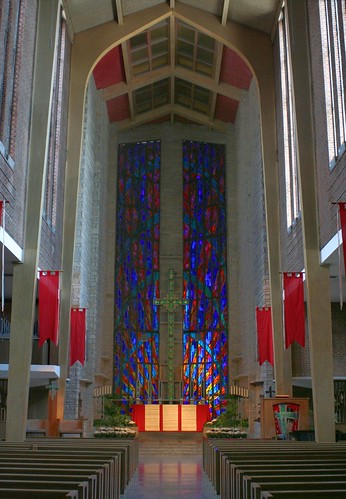
    From the flat lands of the exurban town of Valparaiso, Indiana, the Chapel of the Resurrection rises like a Gothic cathedral, soaring above its everyday surroundings. And a cathedral it is, in spirit if not fact.

    The interior

    Begun in 1956, the chapel is the masterwork of prolific Modernist Charles E. Stade (1923-1993). Stade's practice was based in Park Ridge, Illinois, and produced hundreds of churches throughout Chicagoland and across the country. Locally, his numerous A-frame churches are easy to identify by their window walls of random colored cathedral glass; Immanuel Lutheran in Des Plaines is typical: modest but attractive, modern without extravegance.

    But in Valparaiso University, Stade found a client with the funding to match his full lofty potential.

    Stained glass wall

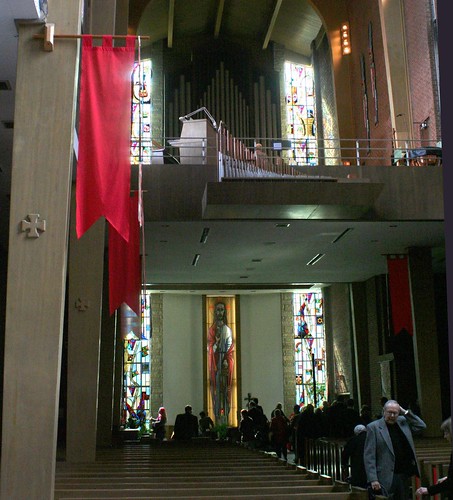
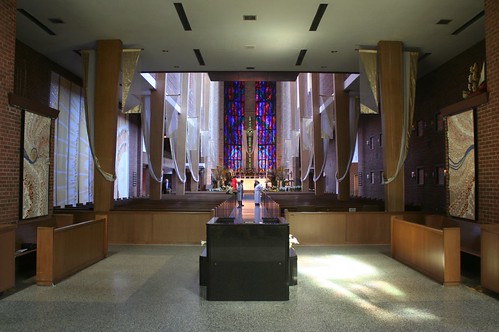
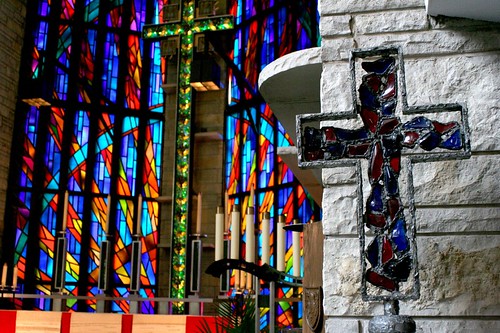
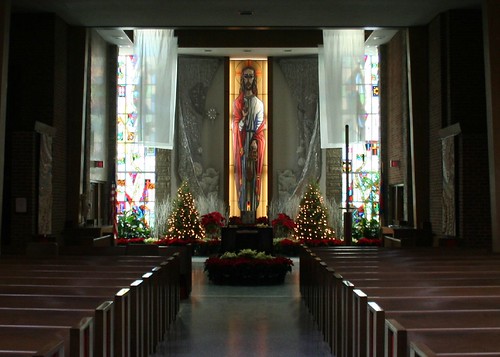
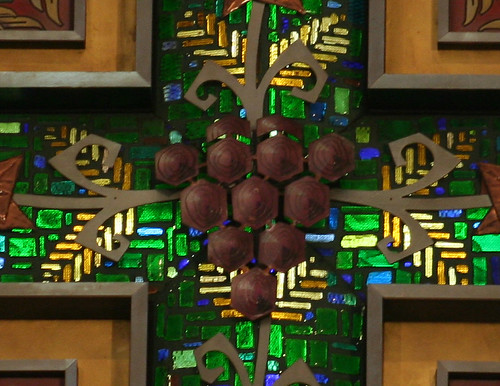
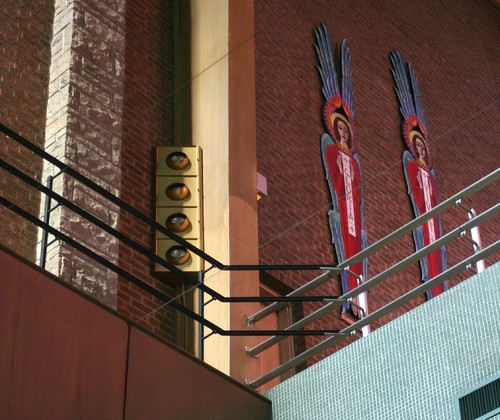
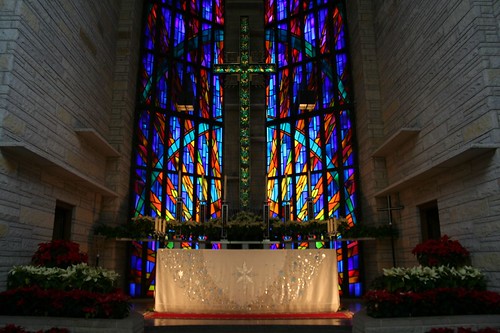
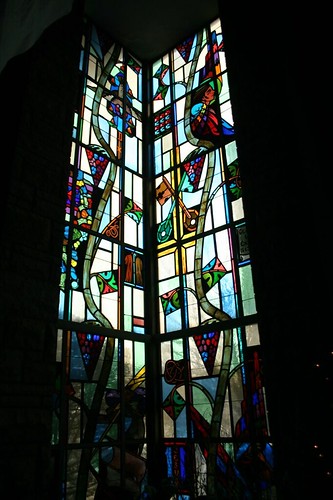
    The chapel's nave is the centerpiece, a towering cylinder of glass and light, rising nearly 100 feet to the top of its jagged roofline. Stained glass figures and patterns descend from the top and disappear below the floor. Their Cubist and Deco influences are echoed in the decoration of the altar table, as well as a mural near the chapel's west entrance. Known as the Munderloh Windows, the glass was designed by Peter Dohmen Studios of Minnesota, who presumably designed the matching altar decoration and an exterior mural as well.

    Altar and glass

    Chapl of the Resurrection, Valparaiso University

    Chapl of the Resurrection, Valparaiso University


    Chapl of the Resurrection, Valparaiso University

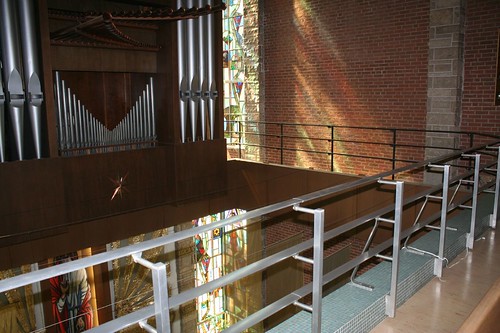
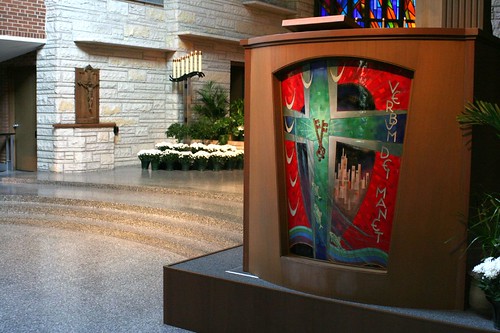
    Beautiful, elegant, simple details suffuse the interior. The pulpit floats next to a curved wall of stone. Free-floating stone slabs form the steps leading up to it. Towering polished brass chandoliers decend from the ceiling. And the organ screen is a delicate screen of tracery in wood.

    Midcentury confection

    Chapl of the Resurrection, Valparaiso University

    Chapl of the Resurrection, Valparaiso University

    The nave and chancel are the main attractions, of course, but there's more as well. Below the chancel, a far smaller chapel coontains similar details on a more intimate scale.

    Ground floor chapel

    At the building's west end, a circular stairwell doubles as a symbolic baptistry, with delicate sculpture pouring down toward a fountain at the bottom.

    Stairwell

    Valparaiso is a surprisingly short drive from Chicago, an hour or less. I did not get the chance to explore the rest of the town, but this building alone made the detour well worth the while.

    The interior

    Links:

  • Official web site
  • 2006 newspaper article about the chapel

  • Tuesday, January 20, 2009

    Carbide and Carbon Building

    Mostly I just wanted an excuse to post this composite photograph. Betcha can't spot where I spliced 'em together!

    Carbide & Carbon Building

    The Carbide and Carbon Building went up in 1929 to the designs of Daniel and Hubert Burnham (sons of the famous city planner). It represents the absolute pinnacle of Jazz Age elegance. Its materials are sumptuously rich, its ornament lavish, its design stylishly geometric, its massing in harmony with the spirit of the age (not to mention the zoning codes.)

    Carbide and Carbon Building

    Carbide & Carbon, up close

    Carbide and Carbon Building

    Carbide and Carbon Building

    Carbide and Carbon Building

    If you've never been inside, do so. The public spaces aren't huge, but they are as stylish as the outside.

    Carbide and Carbon Building

    Carbide and Carbon Building

    The building was originally office space and display areas for Union Carbide. It was converted to a Hard Rock Hotel in 2004, meaning the lobbies are essentially public space. Feel free to wander in! There are no pubic spaces on the upper floors, sadly, though one group of upper-floor suites does have an entry foyer dressed up as a sort of medieval monastery.

    But it's no substitute for an observation deck. Imagine what it must be like to go up in the lantern!

    Carbide and Carbon Building

    Monday, January 19, 2009

    Midcentury Suburbs Part 5: Fabulous Escutcheons

    Those fantastic Midcentury pattern doors needed hardware to match, and companies like Schlage and Kwikset were happy to provide them. (Both companies are still major door handle manufacturers four decades later.)

    The two open-backed designs below are both from Schlage, dating back to 1956: the Manhattan and the Continental, respectively.

    Ring plate

    Squared ring

    Schlage, by contrast, went for the starburst designs, including the two below.

    Starburst with a round backing plate

    Starburst

    Heavy round designs were also common, simple but massive plates with textured patterns.

    Basic round & heavy

    Complex round

    And then I've encountered a few that are seemingly unique, elegant patterns of unknown inspiration and as-yet undetermined manufacturer.

    Onassis fabulous

    Equilateral polygon

    Some kind of Aztec thing or something

    Finding these bits of hardware takes a bit of diligence, a lot of peering into the shadows and past the trees and bushes and screen doors. They don't pop out like a spectacular building does. It's rare that a good photograph can be taken from the public right-of-way (once or twice I've indulged in a little benign trespassing to get the shot!), so getting a good capture is all the more rewarding.

    Sunday, January 18, 2009

    Mather Tower

    Mather Tower

    The AIA Guide to Chicago likens it to "a terra-cotta Gothic rocket poised for takeoff". Unbelievably slender, the Mather Tower rise some 42 stories above the Chicago River at the north edge of the Loop. It is one of a half-dozen skyscrapers from the 1920s which form an unparalleled ensemble where Michigan crosses the river. Together with the river, the vast sidewalks, the ornate bridges, and the multi-level streets, these towers collectively make this intersection one of the world's greatest urban spaces.

    Mather Tower

    Designed by Herbert Hugh Riddle, the building was once the Linocln Tower, and now goes by the uninspired title of 75 E. Wacker Drive; however, it was built as the Mather Tower in 1928. It was headquarters for the Mather Stock Car Company, a manufacturer of railroad cars. Plans for an identical twin next door were scrapped with the coming of the Great Depression.

    Mather Tower

    Mather Tower

    Mather Tower

    In the 1990s, the building's terra cotta skin was deteriorating. Pieces had fallen off and reportedly hit pedestrians on the sidewalks below. Much of the building was wrapped in netting, prior to a complete restoration of the exterior.

    Mather Tower
    October 2000

    Mather Tower

    The building's cap is actually a prefabricated replacement, installed in 2002 after the deteriorated original had been removed. Unfortunately, though intended to be a duplicate of the original cupola, it doesn't integrate with the original tower in form or color. Compared to the original, it clearly reads as the tacked-on replacement that it is.

    Mather Tower

    Still, we're lucky to have the cupola at all. Restoring it involved a few million buck in TIF money and tax abatement.

    Mather Tower

    Mather Tower

    Mather Tower

    Sunday, January 11, 2009

    Tracking MidCentury Architecture

    I've been keeping tabs of my travels and explorations, and compiled them into a rough map over at Google. Chicago MidCentury Architecture marks notable churches, neighborhoods, and a handful of individual buildings from the 1950s and 1960s.

    Wednesday, November 19, 2008

    St. Gall Catholic Church

    St. Gall Catholic Church

    In 1956, this UFO of a building touched down at the busy intersection of 55th and Kedzie. It hovers there still today, a circular pie-slice of building fronted by a thin-shell concrete pod. Architects Pavlecic & Kovacevic designed a stridently Modern building, utterly free of historical associations in ornament or form.

    St. Gall Catholic Church

    The baptistery is a building within a building, a circular form rendered in glazed orange brick, inset with gold-finished crosses.

    St. Gall Catholic Church

    The stained glass is unobtrusively simple, not particularly groundbreaking, but adequately modern.

    St. Gall Catholic Church

    Quite a few ornate period details remain. Check out the mosaic-tiled baptismal font, the grid of screens behind the altar, and of course that fabulously Fifties glossy blue-green brick.

    St. Gall Catholic Church

    The Stations of the Cross are done in a more stylized fashion than the stained glass, more befitting this stridently jet age building.

    St. Gall Catholic Church

    St. Gall is a shouting punctuation amid all the background paragraphs of the neighborhoods east of Midway Airport.

    Link: A history of the church, with detailed information on this building, as part of a tour of church organs.

    Sunday, November 16, 2008

    Chicago rallies against Proposition 8

    Against the cool backdrop of Mies van der Rohe's Modernist towers, amid the chill of November weather, warm camaraderie carried the day as thousands* of people flooded Federal Plaza Saturday morning to rally against the passage of California's Proposition 8, which bans same-sex marriages. It was part of the National Day of Protest, a simultaneous gathering of pro-gay rights activists and supporters all across the country.

    * around five thousand folks, if I had to take a stab at it. The Sun-Times calls it 2,000, but that sounds way too small.

    Chicago rally against Proposition 8`

    Chicago rally against Proposition 8

    A succession of speakers addressed the crowds, with a range of messages, ranging from hope and love to self-righteous fury. But the overriding themes of the day were hope, rationally focused anger, and continued peaceful but forceful activism. Prop 8 may be a California state law, but ultimately it affects all of us, in Illinois and beyond. It's a matter of civil rights, of separation of church and state, of the government unduly interfering in private lives, of discrimination... the list goes on and on.

    A pathetically tiny group of counter-protesters gathered across the street, bearing such unconvincing slogans as "IT'S NOT NATURAL". The rally crowd pretty much had wit firmly on their side, however. Some choice samples:


    • "When do I get to vote on your marriage?"
    • "Focus on your own family."
    • "Homophobia is so 1997"
    • "Church and state... not such a good marriage!!!"
    • "If God didn't make homosexuals, there wouldn't BE any!"
    • "In 1967, 16 states banned interracial marriage"
    • "Overcome H8 / Overturn 8"
    • "My faith backs MARRIAGE EQUALITY"
    • "Tax exemption - take it away"
    • "Gay marriage doesn't scare me / but no healthcare does!"
    • "Land of the free? It's unConstitutional to take away my rights!!! I pay taxes too!"
    • "Our love does not affect your religion"
    • "If a child needs a mother and a father, then OUTLAW DIVORCE"
    • "What kind of family teaches hate and discrimination?"
    • "No state shall deny to any person within its jurisdiction the equal protection of the law"


    Man, I kinda like that last one. They should make it a law or something!

    After the last speaker finished, a short march followed, with the crowd trooping down Adams Street and up Michigan Avenue toward Millennium Park.

    Chicago rally against Proposition 8

    Traffic was briefly obstructed when part of the crowd decided to hang out in the middle of Michigan Avenue instead of marching onwards, which was about the only thing I really disagreed with. Pissing off some taxi drivers rarely helps anything.

    Chicago rally against Proposition 8

    Saturday, November 8, 2008

    University of Chicago Law Library

    UofC Law Library

    It's not often you just stumble across an Eero Saarinen building, especially one just coming out of an incredibly thoughtful renovation. Yet that's exactly what happened to me recently on a stroll across University of Chicago's campus. I noticed and was immediately captivated by the Laird Bell Law Quadrangle.

    UofC Law Library

    Saarinen, by all accounts, was a terrible Modernist. People liked his buildings, for starters; they have creativity, individuality, and flair. Furthermore, this building actually acknowledges all that dreadful historicist stuff that surrounds it; instead of having the building shining like a crown upon the very hilltop in splendid isolation, Saarinen intended the library's profile to reflect the verticality of the campus's NeoGothic buildings, and even uses one of those NeoGothic walls as part of the quadrangle. Shameful! Quick, somebody take away his Modernist card!

    UofC Law Library

    The library is, of course, spectacular. Its Modern interpretation of a castelated roofline (and arcade) are thin facades, but the in-out rhythm of the bays is matched by the floorplates behind them. And when you get inside, you find that the study spaces actually follow that rhythm, turning a long narrow corridor into a space that dances. And look at those tables!! They're custom-cut to match the angles of the building!

    UofC Law Library

    But I'm getting ahead of myself. One arrives at the D'Angelo Law Library through a lovely minimalist courtyard, occupied by a millimeters-deep reflecting pool. Entering the building is a bit of a challenge; the very obvious, invitingly-placed front doors are, of course, locked up tight. Modern institutions have an incredible talent for taking wonderful main entrances and bolting them shut, then forcing visitors to wander around to some obscure and uninspiring side entrance, and so it is here. It doesn't help that small signs on the front door actually send people to the wrong set of doors. Whoops.

    But once you finally get in...

    UofC Law Library

    ...the interior is grand. The building makes handsome use of its waffle slab floor plates, placing a light fixture in each one. This gesture creates a glowing grid, making a decorative asset out of something that's all too often just left hanging there unadorned.

    UofC Law Library

    The main reading room is a masterpiece, cool and sophisticated, spotted with decorative furniture. The main staircase descends smoothly from the mezzanine level, as much sculpture as fixture. The renovation has placed fittingly-styled furniture in strategic locations; these splashes of bright color contrast with the cool tones of the building itself.

    UofC Law Library

    UofC Law Library

    The cool interior is also offset by the generous amounts of natural light flooding the study areas along the building's perimeters. With walls of glass, students practically float among the trees as they pour over their books.

    In the wake of a masterful renovation by OWP/P Architects, only a few subtle clues differentiate the old from the new. The stainless steel standoffs supporting many panes of interior glass, for example, are not something that was in common use 50 years ago. Yet their cool simplicity fits perfectly with the building's aesthetic. Some quick online digging reveals the vast extent of the renovation, which is a shock considering the final product. Clearly the architects understood and cherished Saarinen's original intent -- it shows in the stunning beauty of the final product.

    Links:
    - Wall Street Journal

    Friday, November 7, 2008

    Howard Street

    Howard Street marks most of Chicago's northern-most limit, though the city line jumps a few blocks northward from Clark Street to the lake. Walking down Howard, though, you wouldn't suspect you were on the farthest hinterland of the great metropolis. Howard is fully qualified to be the main street of an entire town, with grand commercial buildings, a magnificent theater, and highrises both old and new.

    Howard Street

    The catch, of course, is that Howard marks the end of Chicago in technical terms only. To the north lies the great suburban town of Evanston, only the first of many suburban outliers that stretch nearly to the Wisconsin border. In that sense, Howard is not very far from the center, and its compelling architecture merely reflects that fact.

    Howard Street

    Howard also benefits from its status as a transportation hub. The Red Line, one of CTA's busiest rail lines, terminates there, handing things off to the suburban Purple and Yellow lines. Numerous bus lines arrive here as well.

    Howard Street Red Line entrance

    Howard has a reputation as a not-so-nice place in general, a reputation which tends to spill over to the rest of Rogers Park. It's a bit inexplicable, given its location. Well-served by rail and bus, sandwiched between tony Evanston and the inevitable northward march of gentrification, only minutes away from the lake, it is only a matter of time before real estate here goes through the roof. When it happens, the architecture will be waiting.

    Howard Street

    Howard Street

    The Paulina Building is just one of many ornate highlights along the strip. Another is the Werner Brothers Fireproof Warehouse, a brick box with a fancy front.

    Werner Brothers Fireproof Storage building

    Werner Brothers Fireproof Storage building

    Werner Brothers Fireproof Storage building

    The high point is the Howard Theater Building (Henry L. Newhouse, who also did the south side's similarly-styled Atlantic Theater.) Like so many other Chicago neighborhood theaters, it was built in 1917, in the rush of post-World War I escapism. The auditorium was razed in 1999, but the lobby and commercial portion remain, converted to condominiums, and still spectacular.

    Howard Theatre

    Clad in shimmering silk

    Howard Theatre detail

    Heading east, there's a short gap for a public park, followed by another jewel, a massive 1925 apartment building named the Broadmoor. The entrance and the corner shield ornament are both extravagantly luscious.

    Howard Street

    The Broadmoor

    The Howard Street commercial district comes to its eastern end not with a bang or a whimper, but with a delightful profusion of 2- and 3-story flatiron buildings, a reaction to the acute angles cut by Rogers Avenue as it slices through the orthogonal grid.

    Howard and Rogers

    Flatiron

    Like S. Michigan, the district is a sampler of architectural styles and trends, yet totally different in its atmosphere. Its prospects are likewise different; a huge condominium building recently went up, testifying to this area's rising future. The problems will pass away in time; residents may well struggle with the rising costs. But the beauty of the architecture will remain.