Showing posts with label historicist churches. Show all posts

Monday, April 23, 2012

Church Conversions

What happens to a church when the congregation moves on? There are four basic answers: demolition, abandonment (which often leads to demolition), reuse (by a new congregation), or adaptation.

Adaptation is rare. Church sanctuaries are specially suited to their particular purposes: the frequent meeting of a large group of people witnessing a singular recurring event. Functionally speaking, the only similar purposes in modern society are movies and plays, and the world only needs so many playhouses. Most adaptations require some radical alterations to the space.

Nobody likes to see the grand space of a church sanctuary obliterated, but if the alternative is the complete loss of the building, it seems like a palatable trade-off. And, surprisingly enough, it is a compromise that's been made quite a few times in Chicago.
IMG_8456

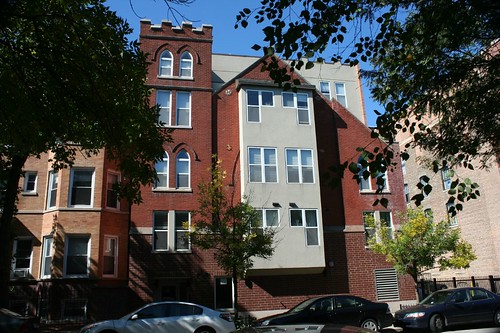
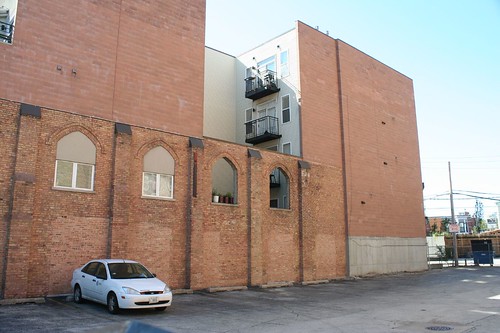
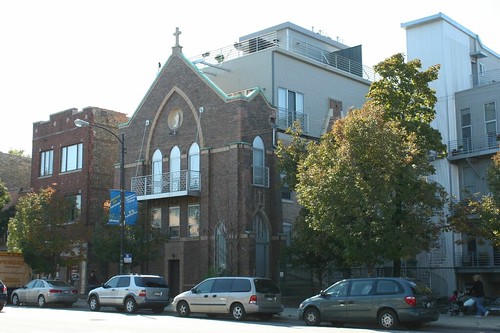
3516 N. Sheffield, in Wrigleyville, is one of the more extreme examples. Here, almost the entire existing building was hacked away, leaving only the front facade and a low portion of the side walls. Out of this fragment grows an entirely new condominium-style building. Even the front window was removed, covered up with a new bay window projection.
IMG_8459

This was originally the Lake View Swedish Church (later the Lake View Evangelical Free Church), a congregation begun in 1887. Faced with the relocation of its members to the suburbs, the church moved out in 1954 to a new building at Touhy and Melvina in the northwest suburbs, becoming the Edgebrook Evangelical Free Church.

The old building on Sheffield was occupied by the Church of Christ, Presbyterian, a Japanese congregation formed during World War II to serve relocated Japanese residents; it held services in both English and Japanese to meet the needs of first and second generation Japanese-Americans. This congregation in 1998 moved out west to the Albany Park neighborhood, near Kimball & Peterson; the old building was converted to residential use by a developer who hoped that preserving the old structure to some extent would give him a better shot at a zoning variance. 1 The most ingenious use of the old structure is here, where a former sanctuary window opening now admits light and air to an enclosed porch.
IMG_8464


IMG_8617a

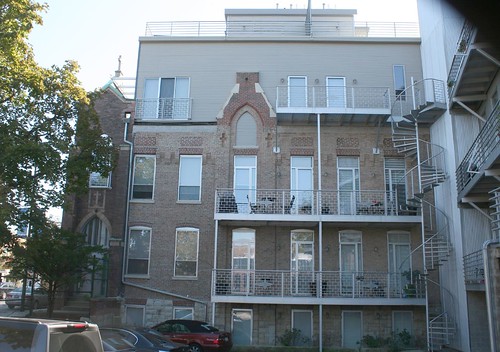
A similarly radical reconstruction happened to 916 N. Western Avenue, an 1888 church building previously home to Our Lady of Good Counsel Catholic Church, a Bohemian and Slovak church that closed in 1989 due to a dwindling congregation and rising debts.2 3 The conversion removed the roof and interior, and includes new balconies on the front facade.
IMG_8626a


But not all church conversions are so destructive. This 1893 church at 2558 W. Cortez retains its original form and still has the sanctuary space largely intact4 Of course, it's easier to keep such a space intact when it's being changed to a single family home.

IMG_8661a

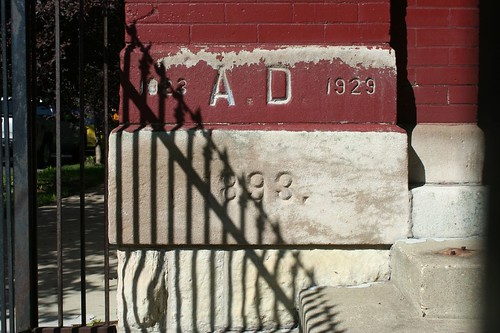
This was originally the Evangelical Bethany Lutheran Church, built in 1893 in what is now Ukraine Village. Around 1925 the congregation relocated west (to a building that still stands at Wabansia and Narragansett, near Oak Park); the Good Shepherd Polish National Catholic Church congregation - Kościół Dobrego Pasterza - moved in, presumably in 1929, based on the cornerstone. It's not clear when the congregation moved out, but today this modest little church has been converted to a not-so-modest home, which sold for $600K in 2010. No word on what the adjacent rectory house is now used for.
IMG_8680


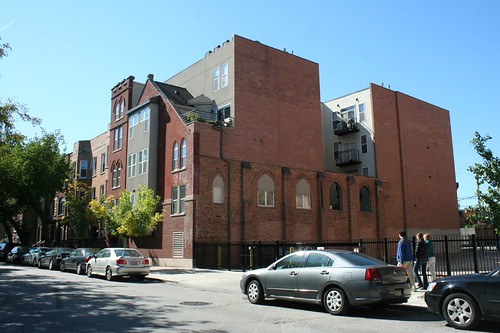
A series of conversions in Lakeview near Belmont best illustrate the common church conversion, in which new floors are constructed within the existing building envelope.

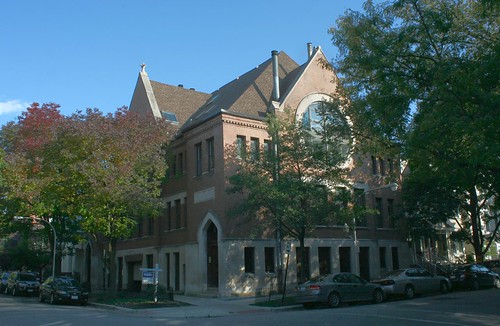
The former Elim Swedish Methodist Church, 1021 W. Barry at Kenmore, was built in 1898, with the cornerstone laid in September of that year. Swedish-language services were discontinued in 1942, when the Swedish conferences were merged nationwide with English-only ones. The building was converted to condos in 1983.
IMG_8702a

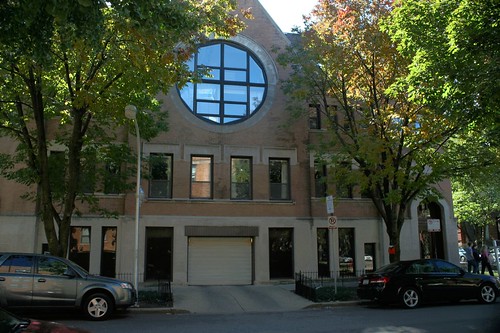
Upper floor units in this conversion retain some of the rafters and eaves of the original sanctuary. 7 A ground-level garage has been added as well.
IMG_8508a


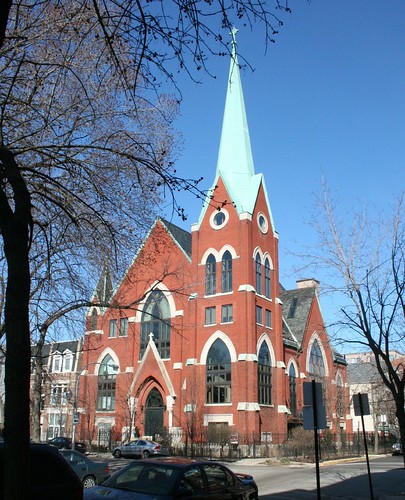
Trinity Swedish Evangelical Lutheran Church - 3101 N. Seminary at Barry - is an 1896 building, constructed to house a congregation founded in 1883. The church's second pastor, who served from 1901 well into the 1920s, gained some notoriety for his remarkable resemblance to President Hoover. Trinity Swedish Lutheran was followed by the Church of the Valley Assemblies of God - per the sign which remains attached to the building!
IMG_7996a

IMG_8000


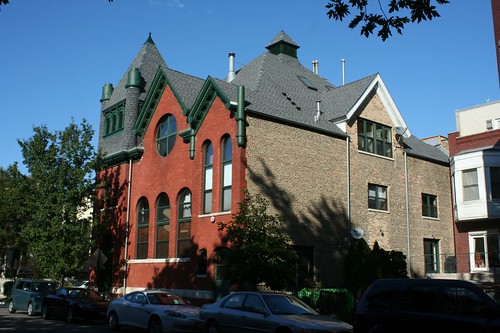
3055/3057 N. Clifton at Barry is a deep mystery - I can find only 1931 and 1937 references to it as Lake View Baptist Church.
IMG_8716

IMG_8710a

IMG_8714a


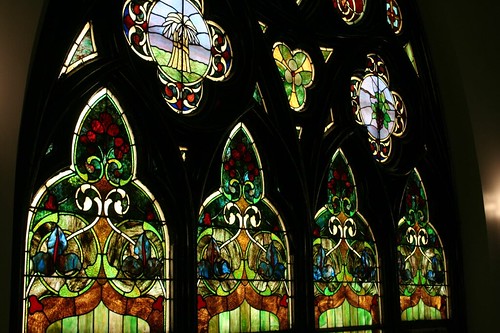
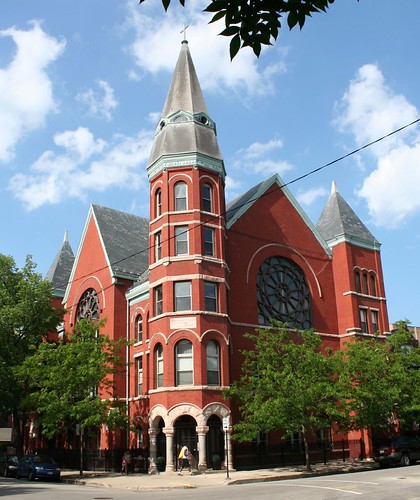
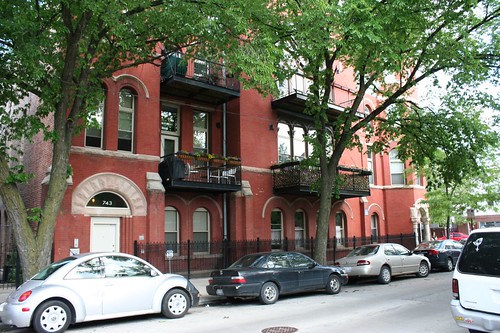
Church conversions do not have to be pedantic or mundane. Witness the former First German Baptist Church (Ersten Deutsche Baptisten Kirche), 1658 Superior at Paulina, now the "Sanctuary on Superior". This handsome converted church, dating from 1888, still retains a portion of its stained glass5 6, making for some truly spectacular residential spaces.7
IMG_7663a

IMG_7666

Monday, September 12, 2011

A remarkable restoration

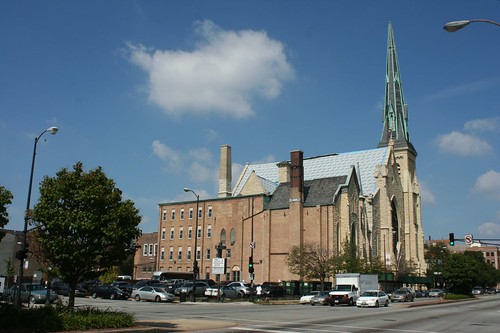
A heartfelt congratulations to the congregants of First Baptist Congregational Church on Chicago's near west side.

IMG_7107

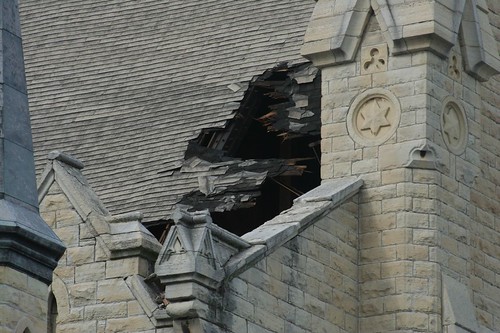
This venerable church was damaged in the intense blizzard that struck Chicago in February of this year. Rooftop masonry was dislodged and tumbled to the street - and through the roof, into the sanctuary. The damage to the historic building was considerable, and it was immediately boarded up.

IMG_5310

In far too many cases, this would be the beginning of a long, slow decline for such an aged church in an older city neighborhood. In this case, however, quite the opposite happened: insurance, bolstered by donations from an enthusiastic and sizable congregation, covered the damage and spurred additional interior work. The south size of the sanctuary is getting a new roof, a work still in progress, and the organ pipes are still out for repairs.

IMG_7105

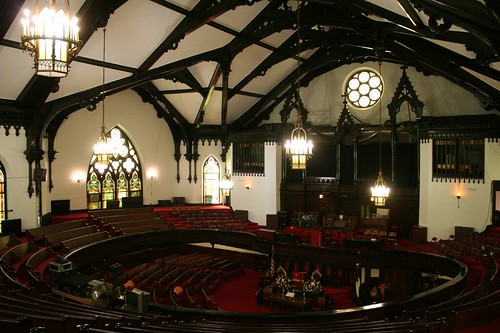
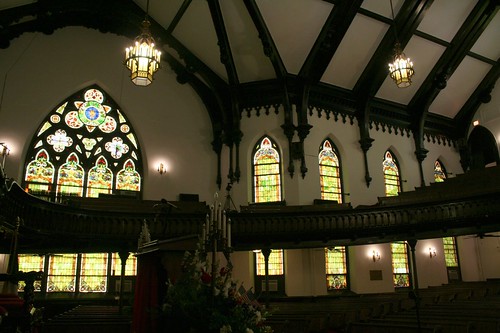
But the bulk of the interior work is finished; and thus, this Sunday, a mere seven months after the blizzard, churchgoers returned to the sanctuary for services.

And what a sanctuary it is!

IMG_7270

First Congregational was begun in 1869 as Union Park Congregational Baptist (architect: Gurdon P. Randall.) It opened in 1871; later that year the Great Chicago Fire burned much of the city to the east (though it never came close to the Union Park area.) Union Park Congregational housed city offices for a time in the fire's aftermath; it would go on to have a long, storied history; in the 20th century, it has been a common stop for visiting presidents.

IMG_7182a

IMG_7255

IMG_7290

First Baptist Congregational was added to the National Register of Historic Places in 2006.

  • Photos of the damage from FBCC's site
  • Monday, January 31, 2011

    Damen Avenue Churches

    Sometimes I snap a totally random photo, and it winds up haunting and fascinating me for ages afterwards. So it was with a shot of a near west side church I took in 2007, the New Holy Bethel Fire Baptized Holiness Church of God.
    IMG_7694a

    IMG_4636
    I returned a few weeks ago to photograph it more intently. Only when I put the old and new photos side by side did I realize that the building has lost the roof and upper section of its turret. There's been some reroofing work, but the roof - the whole exterior, in fact - is in pretty rough shape. The windows were bricked in long ago, and nearly all the stained glass is gone.

    IMG_4647a

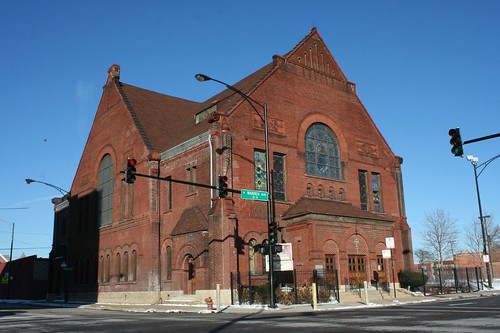
    This modest Romanesque church stands at 1960 W. Adams at Damen, right by the United Center, though prior to Chicago's 1909 street renumbering, its address was 739-741 Adams. The founding congregation was the Seventh Evangelical Church, later the Adams Street Society. They erected a building which would commonly be referred to as the Adams Street Church, with a cornerstone date of 1888. (Other articles refer to it as the "Evangelical Church at Adams Street and Robey", Robey being the previous name of Damen until 1927, and the "Adams Street Church". Most of these articles are the planned topics of Sunday sermons at various churches around town, while one describes the departure of one of its first ministers.) From its purchase in 1885, the church property was embroiled in a massive court fight between two factions of the Evangelical Church of North America. The congregation was also involved with the early Temperance movement.

    IMG_4645

    In 1928 it was sold to a Greek Evangelical congregation, the sales posting in the Tribune noting that "many prominent men" went to the church in the past. A 1953 newspaper ad notes that it was then a branch of the Church of God.

    New Bethel is one of a string of churches along Damen Avenue:

    * West Side Community Church - 1937 W. Adams at Winchster, east of Damen
    IMG_4641a

    The cornerstone of St. Paul's Reformed Episcopal Church was laid on February 22, 1886, and services were taking place in the new limestone building by May. Built at a cost of $38,000, it suffered a severe basement fire in December 1886, but quickly rebuilt. In 1950, police were twice called to the premises to break up scuffles that arose over the pastor's attempt to sell the church to the West Community Church, a black congregation, and the previous congregants' refusal to allow the new owners to take possession or enter the building.


    * Greater Union Baptist Church - 1956 W. Warren at Damen
    William LeBaron Jenney, 1885
    IMG_4661

    This fantastic church building wears some of its history proudly on its facade - a 1950s cornerstone relates that the GUBC was organized 1908, and purchased the building in 1928. Its original builders were the Church of the Redeemer. More on the church building's history can be found on GUBC's website. The exterior features superb terra cotta ornament and stained glass.

    IMG_4674

    IMG_4655a

    IMG_4662b


    * Gospel Temple M.B. Church - 1958 W. Washington Blvd. at Damen
    IMG_4669

    This modest red brick church has a bizarre mansard roof that plunges down between the towers over the entrance. My guess is that there was a much more formal entrance originally, and that this was a way to shoehorn in some office space a long time ago.

    It was originally the Church of St. Andrew, dating back to at least 1886.

    IMG_4667


    The thing about these churches is, churches don't just build themselves. For four churches to have gone up on this one little stretch of road, there must have been a sizable population in the area a hundred years ago. Today, there's almost nothing - just vast fields of parking for the United Center.

    IMG_4625

    When planning for the stadium, originally meant to be a new home for the Chicago Bears, began in 1987, much of the area was already vacant land - 73%, according to the stadium architects, a figure that sounds about right based on some skimming of Historic Aerials.com. The area was devastated by the 1968 riots and never recovered.

    historic aerials
    1972

    historic aerials
    1988

    historic aerials
    1998


    Stadium plans called for the demolition of over a hundred buildings. Banding together as the Interfaith Organizing Project, several churches in the area led the fight against the monolithic stadium, decrying it as a playground for the suburban rich, and protesting the thousands of elderly and empoverished neighbors that would be displaced.

    Plans for a new Bears stadium seem to have quietly died off... only to be revived as an enclosed arena for the Bulls and Blackhawks a few years later. The churches were only able to save themselves; their neighborhood was destroyed. The early newspaper announcement of the stadium plan makes mention of "pedestrian malls", "urban" planning, physical connections to the neighborhood, trees and grassy knolls that would screen the parking lots, economic benefits to the residents of the area - all a hilarious fiction. Destroying the neighborhood was sold as somehow saving it. It's an Orwellian twist of language that continues to be used today by powerful developers who want to get poor people out of their way.

    The result - major building survive, while the fine-grained context that gave rise to them, supported and nurtured them, are washed away. 125 years after the West Side was developed, the surreal sight of an urban church in a parking lot is all that remains.

    IMG_4408a

    Monday, December 6, 2010

    Lake Street Church, Evanston

    IMG_3004

    Lake Street Church is Evanston's oldest (designed 1872 by architect Cass Chapman) and, for my money, the most beautiful. It's Victorian Gothic - tall, narrow windows with pointed arches, and a general sense of verticality. The exterior is a simple affair of plaster (not original; when opened, the building's brick walls were exposed), with only a few bits of ornament emerging at the corners.

    IMG_4003

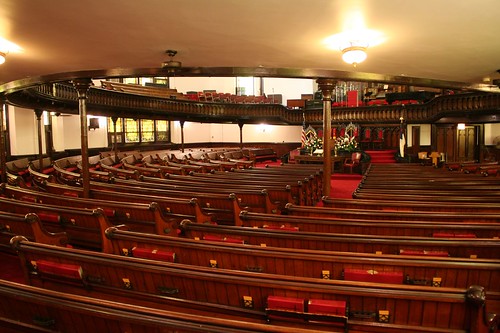
    The simplicity without anticipates the elegance within. The sanctuary is a space defined by dark wood and stained glass in the earth-hued range of tones that inspired both the Prairie and Arts and Crafts movements.

    IMG_4949a

    IMG_4930

    The element that most defines the space is the 2nd-level gallery, which wraps nearly the entire space. According to the head usher, it originally wrapped the entire space until a later remodeling (confirmed by a Tribune article from the building's 1875 opening.)

    IMG_4960

    IMG_4920a

    The head usher shared a couple of other interesting tales. This was the church of Jimmy Carter's daughter, so the President and his wife would occasionally attend services. This would bring the Secret Service pouring in, of course. Being a community church, most of the congregation was recognizable by face to its ushers. A stranger in the gallery turned out to be one of the agents.

    IMG_4918

    IMG_4922A

    IMG_3240

    Lake Street Church was originally the First Baptist Society of Evanston, organized in 1858. Today the church is the oldest public building in Evanston, and an officially designated city landmark.

    IMG_4973A

    IMG_3298

    A later addition forms a courtyard space north of the sanctuary, and contains offices and meeting rooms. The stone Gothic design works well enough with the older building, but lacks its powerful and charming Victorian verticality.

    IMG_3113