Tuesday, January 29, 2008

Devon Avenue in Danger?

Preservation Chicago has just announced its "Chicago 7 list, highlighting buildings and neighborhoods at risk throughout the city.

Of particular interest to me personally is Devon Avenue, the Indian/Pakistani/Jewish commercial street in the city's far northern reaches. It's not very far from where I live, and I pass through fairly frequently. The street's aged buildings, thick infrastructure, and frenetic, multilingual signs give it a charm and intensity unmatched anywhere else in the city. With its dense immigrant population, a visit to Devon Avenue is often like stepping into another country.

World Fresh Market

The street is also home to some fine architecture, including several unusual buildings that straddle the line between Streamline Deco and International Style. More traditionally styled buildings abound as well, in an array of styles. All of it's buried to some extent beneath the plethora of signs that festoon the various stores and restaurants, but it's certainly worth keeping.
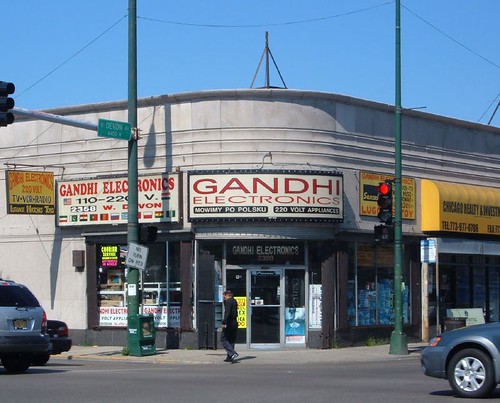
Gandhi Electronics

The survey rather vaguely cites a proposal for new development, but says little in the way of specifics, aside from a rather gaudy new facade (building?) intended for 2552 W. Devon. Without knowing who's planning what, it's hard to say much of anything about the issue.

Video Ace - Pakistani-Indian Movies

More generally, though, I can say this: architects and planners love to sanitize things. Devon Avenue is the kind of jumbled, messy, and furiously successful commercial district that could easily be totally screwed up by some planner looking down, God-like, from his lofty paper perch. Devon Avenue isn't broken by any stretch of the imagination, so it begs the question: who on Earth thinks it needs fixing?

Pakistani Independence Day parade

St. Helen's Roman Catholic Church

A strange fusion of Deco, Modernism and tradition, this church stands on Augusta Boulevard at N. Oakley, in the Ukrainian Village neighborhood due west of downtown.

The sun never shines on the front of this building, so you'll have to settle for a detail shot of the exterior.
St. Helen's Roman Catholic Church

St. Helen's Roman Catholic Church

Inside, it's not the kind of unabashed 1950s Modern I was hoping for, but it's still of great interest -- a Modern floor plan, a ceiling decorated to draw all eyes to the altar, and slits of light washing the altar in an unearthly glow.

The stained glass is mostly geometric patterns in small fragments of bright, unfiltered colors.

St. Helen's Roman Catholic Church

St. Helen's Roman Catholic Church

St. Helen's Roman Catholic Church

A few small designs adorn the windows of the chapel in the lobby, including this Deco-influenced stained glass fish, somewhat reminiscent of the 1950s works of the Emil Frei company down in St. Louis.

I failed to note the date of construction, but I seem to recall a plaque mentioning 1963.

More photos may be seen at my Flickr account.

Tuesday, January 15, 2008

Cook County Hospital

The name is legendary, but I'd never seen the place at all until a few weeks ago, and not till this weekend did I pay it a careful visit.

Cook County Hospital

Cook County Hospital's 1913 main building stretches for two city blocks, and is the preeminent example of Beaux Arts architecture in the city of Chicago. It has long been the centerpiece of a densely developed parcel of land, even as urban renewal, decay, parking lots, and freeway construction (all equal blights on society) have smashed the surrounding neighborhoods into oblivion.

Sadly, they're tearing down the building's rear wings, Children's Hospital and power plant, a complex of structures added in 1914, 1916 and 1926. It's a compromise -- for a long time, the County wanted to tear down the entire building, magnificent front facade and all.

Cook County Hospital

The rear pavilions aren't great works of art, but they have several merits -- a creative floor plan that brought natural light to many acres of floor area, and a dense complexity that makes the building look like a city unto itself (much akin to St. Louis's City Hospital, a likewise neutered complex).

Cook County Hospital

Demolition's nothing new to this neighborhood. For fifty years, the prevailing wisdom in this part of town has been the same lunacy that has driven so much of our so-called "urban renewal": in order to save it, we must destroy it. This was the view around the hospital some while before the freeway came through:

Cook County Hospital - old context

And here is the same area, showing the disastrous results of fifty years of "progress":

Cook County Hospital - context today

Cook County Hospital - context today

A dense, walkable urban environment has become a wasteland of vast parking lots and roaring limited-access lanes. Whatever happens to Cook County Hospital, the most vital battle was lost long ago.

(Also darkly hilarious is the formal park laid out in front of the hospital -- half of it has been stripped of its trees and turned into a helicopter landing pad. Tragic on the surface, but who's around to actually use the thing?)

Monday, January 7, 2008

They are Mohammedans in faith, polygamous in custom, and bandits by instinct

Something remarkable happened to me while in St. Louis last weekend. I mentioned -- just in passing -- that I lived in Chicago, and a fellow just gave me a book he'd gotten off of eBay. Just like that!

The book bears the unwieldy title of The Magic City: a Massive Portfolio of Original Photographic Views of the Great World's Fair and Its Treasures of Art, Including a Vivid Representation of the Famous Midway Plaisance, and it is, of course, a compilation of photographs from Chicago's 1893 World's Fair. It was published in 1894, the year after the fair's magnificent run. As might be expected from a free, 113-year-old book, the copy I got is in "poor" condition: the pages have some water damage around the edges, many have developed a purple discoloration, and the binding has pretty much come apart. But the photographs are still in fine shape and all the text is there.

The photos are mostly 8x10, so they have massive amounts of detail. They include overviews of the fair grounds, shots of each major building (including at least one view of Sullivan's Transportation Building that was new to me), and many shots of the exhibits -- including the many indigenous peoples shipped from around the world to be displayed at the fair.

It's an incredible document of an incredible event, and a window into a time whose mores and values were often quite different than our own. The sheer scope and scale of the fair is mind-blowing to behold. Architecturally, it was a time when people loved their buildings unabashedly:
As the Manufactures Building held the wondering interest of multitudes by the unexampled magnitude of its dimensions, so the Administration Building struck with amazement, and won the unstinted admiration of every World's Fair visitor by its incomparable beauty and artistic magnificence.

Culturally, Victorian society was equally sure of itself:
A typical Bedouin, with his main transportation dependence [a camel], stands before us in the photograph, nothing being omitted in the characterization of the roving bandit of the Asiatic Steppes, as he is seen in his own desert country. His tarboosh, bournouse and gibbeh, his trusty scimeter [sic], and a countenance reflective of the cruel instinct that he vainly seeks to hide beneath his richly colored robes, are conspicuous as they are typical. His patient beast of burden, demure, but equally treacherous...

Our illustration is one of two Sioux men, whose style of dress shows the result of contact with civilization. In earlier years their rainment was principally a breech-clout and blanket, but progress has effected changes, which, though gradual, will in a few years more eliminate every appearance of savagery in the dress and customs of the plains Indians.

....and amazingly odd:

Babies of strange peoples have a fascination for us grater even than have the customs which often excite our amazement. Indian mothers have always found large profit in exhibiting their papooses to overland travelers, and who is it that would not give a quarter for a peep at a real Chinese baby?


The exhibits were lavish beyond compare: sculpture, furniture and paintings from around the world. Machinery of all types. Native dwellings. Dioramas. Entire mock streets and villages. The world's first and still largest Ferris Wheel. Secondary buildings that are all but forgotten against the grandeur of the main buildings, but would be landmarks in their own right if they still stood today. Today, little remains of the fair besides the Museum of Science and Industry's grand building, and the Wooded Island that stands in a lagoon behind it.

It's nothing short of amazing that nobody has re-issued this remarkable document.

Saturday, December 8, 2007

A Mid-Century Cornocopia

Western Avenue long marked the western boundaries of the city of Chicago. And today, it remains something of a dividing line -- an identifiable centerline to the amorphous region where the city's urban environment begins to weaken, falling apart into 1950s suburbia.

This means, however, that streets to the west of it have treasure troves of Mid-Century Modernism.

Most awesome showcase lamps ever.

The whole shooting works

Concrete pattern wall

Peterson Avenue, west of Western, offers one 1960s building after another, with a nearly complete array of the stock design elements and styles common to the period. Delicious details abound, easily overlooked as motorists zoom past at 50mph, but easily found if you make the trip by foot or bike.

Colored glazed brick, raised metal letters, funky stainless steel railings, crazy hanging lamps in the lobby, jagged fieldstone contained in limestone borders on brick walls... it's all here.

Glazed brick

1960s stone and brick

Even the side streets offer the occasional find:

Apartment door

And sometimes, the MCM creeps east of Western:

One day, I'm coming back after dark for this shot.

There's no knockout buildings out here, nothing to make a MCM preservationist stand on the mountaintops and shout; instead, there's a collection of buildings that reinforce each other, crying out the optimism and elegance of the 1960s, achieving far more together than any one of them does alone.

Sunday, November 25, 2007

Buildings of Humboldt Park

Humboldt Park -- between North and Division, a bit west of Western -- isn't really hidden, but it's easy to not really know about or visit. I paid it a visit by bicycle a while back. It's in a neighborhood that feels transitional -- old clans and residents still around, but starting to dwindle; newcomers with a bit more money to spare moving in to escape rising prices to the west. People fish in the lagoons, children run wild in the fenced play area, and a fantastic drum jam was going on when I passed through on a Saturday afternoon.

Humboldt Park lagoon

Three of the park's buildings are worthy of special note:

Humboldt Park stables

The old stables building is fairy tale architecture at its best. There are ten thousand photos hidden in those gables and red tiles. It's been under renovation for a long time; it suffered a fire years ago, but looks great today.


Humboldt Park bath house

The Tudor Gothic bathhouse faces an empty lagoon at present.


Humboldt Park pavillion

An open-air pavilion shows a Prairie School influence, echoed in a formal garden court nearby.

Saturday, November 24, 2007

Mid-Century Suburbs, Part 1

South Chicago house

South Chicago house

South Chicago house

They cover mile after mile of street grid in the far southern reaches of Chicago and its inner suburbs. They are simple houses, small and modest, one story over basement, shallow-pitched roofs, built for narrow lots -- but they are distinguished by the endless variation of a few simple elements: brick color, horizontal limestone accent bands, three-paneled screen doors, doors with geometric window designs, groupings of single glass blocks, groupings of colored glazed tile.

The colored block

The overall unity of their style and details seems to suggest a single builder -- but could one company have built all this? These houses cover miles of land; there are thousands and thousands of them. Dense concentrations can be seen on the streets around 79th Street and 85th Street, as they leave Chicago and enter Burbank and Bridgeview.

They delight in their tidy, well-kept ranks; they charm with their little accents that suggest individuality even within the confines of a limited design scheme.

They are supplemented by a series of three-flat and six-flat apartment buildings, which share some of the same details -- particularly the colored block. More on those in the future.

Thursday, November 22, 2007

Layin' it on thick in Pilsen

This house sits on the 1600 block of W. 16th Street, right across from the magnificent St. Adalbert's Church.

A house....

It's a mini-Parthenon, grandeur wrought on the smallest possible scale. Or at least it wants to be grand. In truth...

....with delusions of grandeur.

...it's a puffed-up ordinary gabled brick house, with a Classical facade sitting in front of it.

But I love it. It's such an oddball among all the standard brick and wood siding, and it's obvious that whatever else the owner was thinking, they really really wanted it to be special.

Wednesday, November 21, 2007

St. Paul Missionary Baptist Church

St. Paul Missionary Baptist Church

Came across this place on a long slow trek across the south side today. It's on a side street near Halsted -- 6954 S. Union Avenue, say the Internets.

What got my attention was the crazy colored glass front elevation, which was clearly a 1960s design tacked onto a much older building. It's a strange, jarring, but colorful juxtaposition.

Yet, looking again, the towers share the same stone crosses as the 1960s building next door, as well as same the square glass block that demarcates so much of far south Chicago's Mid-Century housing. So they appear to be a 1960s job too -- but there's vintage stained glass in their windows, and an older corner stone on that facade. Very puzzling!

St. Paul Missionary Baptist Church

The sign and adjacent office/classroom building look to be of the same vintage as the facade. Check out the engraved stone crosses on the building facade.

This church is deep in the hard-luck neighborhoods of the south side, so I'm sure they've got their work cut out for them on the missionary front. They don't have a web presence, though they do seem to be home to the Illinois National Baptist State Convention Headquarters.

Tuesday, November 20, 2007

New City YMCA... demolished.

green.  YELLOW!!

What a shame to have to start off a blog this way!

But I can't help it; something special's been lost, and I'm compelled to document.

This was the New City YMCA, a circa-1981 building on Halsted just south of Clybourn, west of downtown, just north of infamous Cabrini-Green.

New City Y

Not much of a building, but oh, those bricks, those glossy glazed bricks!! 9 shades of rainbow-colored glazed bliss. They're tearing it down right now. There's not much left, just a few partial walls and a huge pile of debris.

New City Y rubble


Links:
- YMCA That Served Cabrini-Green Residents to Close
- Redevelopment Planned for New City YMCA

Monday, November 19, 2007

In Search of Chicago

This is A Chicago Sojourn, a Chicago-based photography blog.

View of Chicago

And this is about the only Chicago skyline photo you'll see here.

You also won't find any photos of the bean sculpture in Millennium Park. No Sears Tower. No views from the John Hancock. No shots looking up the Chicago River toward the Wrigley Building. No interior shots of the grand hall in the Field Museum. None of Frank Ghery's titanium nonsense.

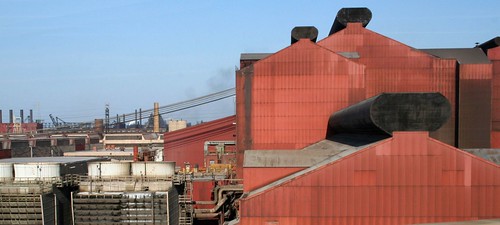
Inland Steel

In my years of visiting Chicago, I did all that and much more. As a resident of this city of millions, my interest has expanded beyond all that, to an endless cityscape filled with places wonderful and terrible, famous and forgotten

It's the forgotten parts that fascinate me.

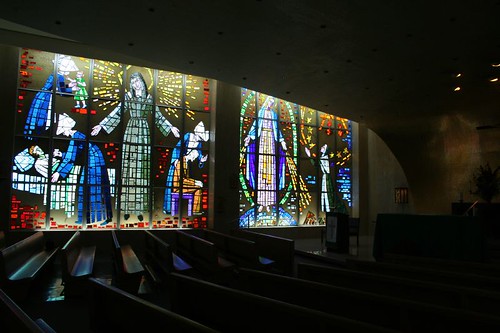
Saint Joseph Hospital Dan Ryan Memorial Chapel

I've always gravitated to the forgotten: in St. Louis, in Milwaukee, everywhere I go. And so it is here.

What IS it?

This blog will be a casual document of my own discoveries, as I continue to branch out and delve deeper and deeper into the guts of Chicago. It will be photo-intensive. It will feature lots and lots of architecture. It will be relatively obscure. And hopefully, it will convey my own sense of wonder and amazement at the endless cityscape around me.

Kenmore Avenue, Chicago

I hope you'll come along for the journey.

Loyola University Chicago