Showing posts with label building types. Show all posts

Monday, October 11, 2010

Alvin Hoffberg's Courtyard Townhouses

"Every visitor says these are Chicago's most beautiful and unusual town homes." - August 7, 1957 Chicago Tribune classified ad
IMG_1019

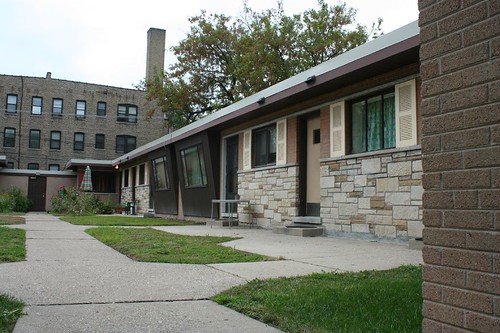
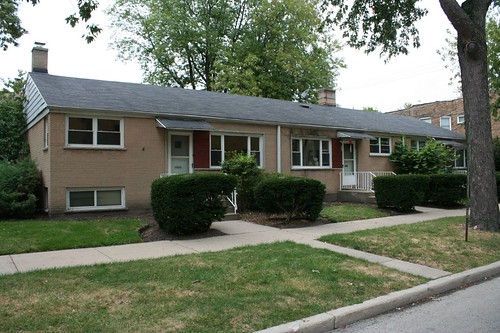
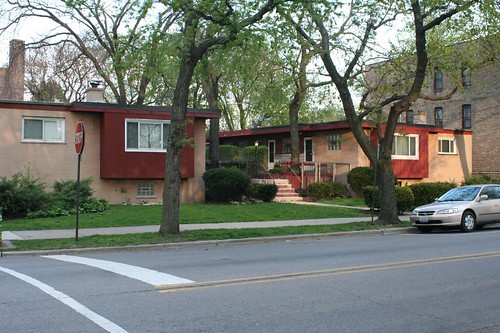
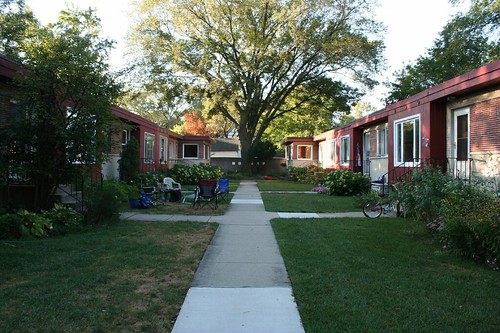
Midcentury builder Alvin M. Hoffberg brought a unique twist on the townhouse to Chicagoland in the 1950s. The Midcentury townhouse is a rare beast indeed, but it does exist, and Hoffberg planted several variations on a similar theme in Rogers Park and Evanston. He developed a series of one-story rowhouses ranged around a long, narrow courtyard.
IMG_7240

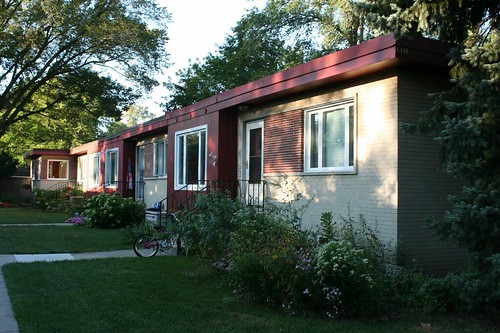
Several decorative features make it obvious that these buildings are all by the same builder, but it was a classified ad for 1338 Main Street, shown above, that finally gave me the builder's name.

(Just so we're all on the same footing - a townhouse, in US parlance at least, is the same thing as a rowhouse - an individual dwelling unit that shares party walls on at least one side with another home, but has its own individual entrance at the ground. In the 1950s, "townhouse" probably would have sounded much more cosmopolitan and appealing than "rowhouse", with its connotations of crowded cities and industrial workers' housing.)
IMG_7238

1338 Main Street shows up in a delightful little classified ad in the 1954 Tribune, advertised as a group of California-styled ranch townhouses:
"Very de luxe [sic] and unusual, on 1 floor, with full basement and roofed patio. Landscaped and decorated to suit. Tiled Youngstown kitchen, colored fixtures in tiled dual bath. Ample cabinets and wardrobes, many other features. Carpeting, utilities and rumpus room opposite. Fine residential area, close to all transporation, shops, schools and recreation."
Hoffberg went on to use this design in several more locations around Evanston and the far north end of Chicago.
IMG_4676

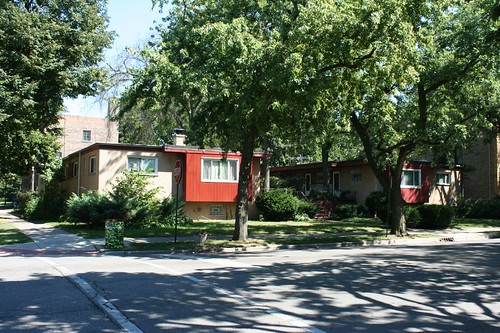
239-45 Custer (Evanston) appears in the classifieds by 1963. Unlike the Main Street group, they're built over a raised basement, which also raises up the courtyard - an extra measure of privacy and separation from the street.
IMG_1020

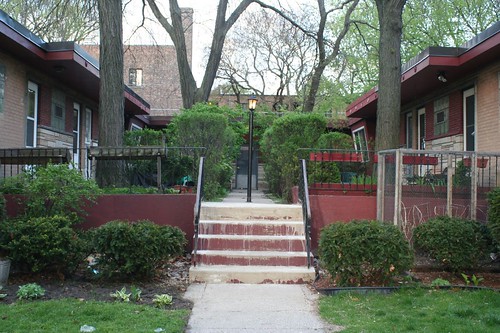
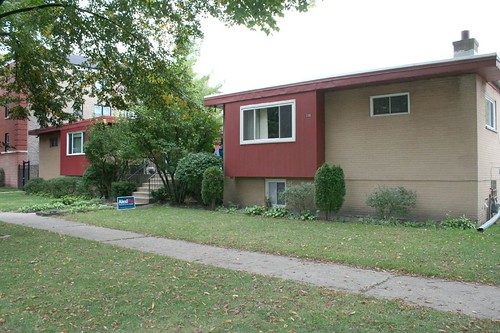
This design pops up several more times around the neighborhood, such as 135 Callan:
IMG_7362a
135 Callan, Evanston

These were advertised as 5-room townhouses, approaching completion in 1955 with prices ranging from $180 to $195 a month:
"For discriminating people who desire the utmost beauty, privacy and comfort, each a complete de luxe home in a choice residential area clos to shops, express "L", bus and train. Spacious rooms, huge wardrobes, snak bar, dispolsa, and de luxe utilities area few features."
IMG_3028

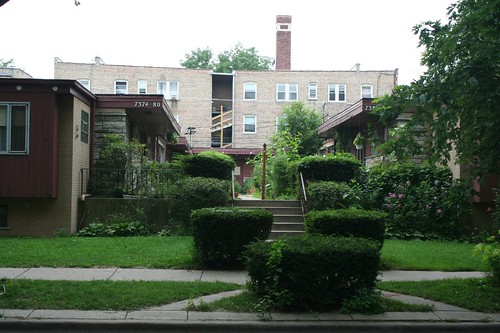
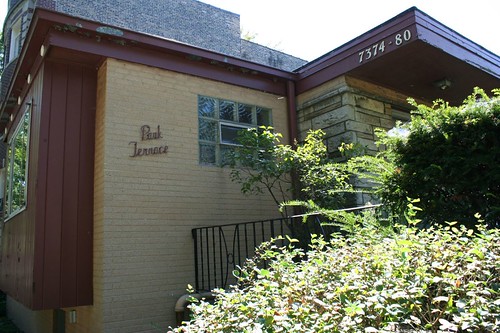
7374-80 and 7382-88 Winchester, named "Park Terrace", stands in Chicago's city limits. Like the Main Street group, 7376 Winchester was advertised in 1959 with an emphasis on its fabulous rumpus room. Alvin M. Hoffberg, builder could be contacted at 6131 N. Sheridan.
IMG_3031

IMG_4673


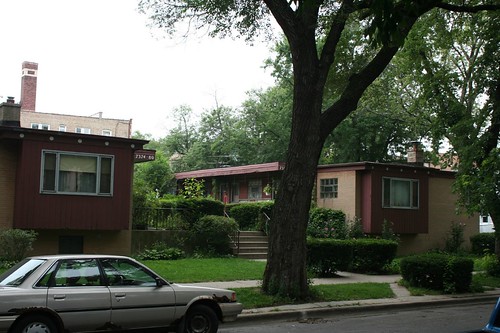
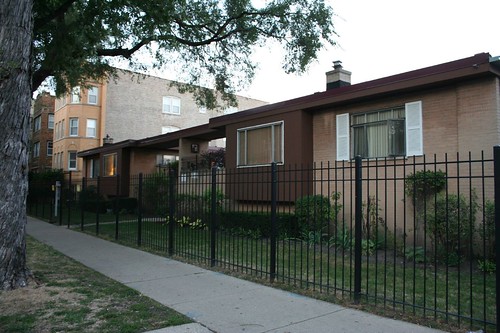
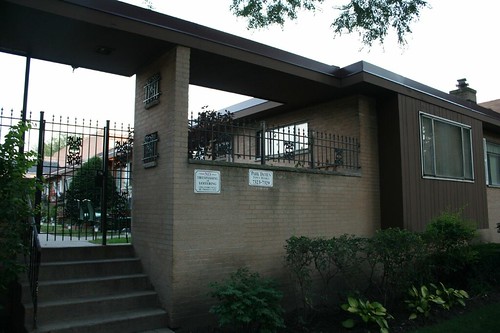
A variation on these designs stands nearby in northern Rogers Park, marked by an entry gateway.
IMG_7301

IMG_7293
This is 7323-29 Damen (or maybe just 7327 N. Damen); at any rate, it's the Park Damen Town Homes. A resident of this site died in 1958; I have to wonder if his home was sold to make way for this building, which a real estate agent lists with a 1960 date of construction (CityNews says 1957, but they can be real wonky sometimes.)

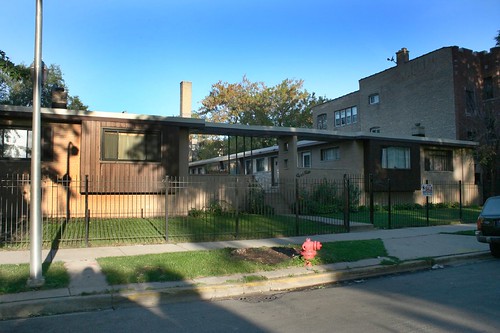
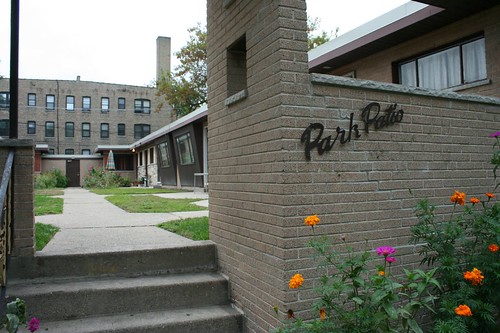
This group has a twin to the east, the Park Patio at 7342-44 and 7346-48 Winchester (where, perhaps not coincidentally, another owner died in 1960.)
IMG_7230a

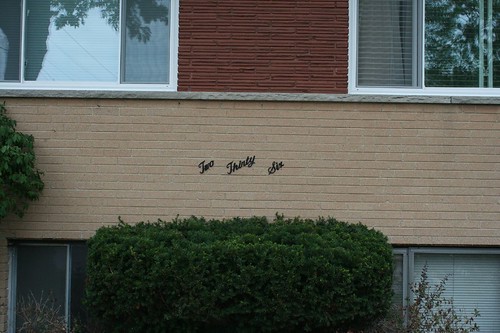
Not only does it have the same sloped bay windows as the wood-siding buildings, it's got the same little cutesy development name in the same kind of cutesy font as the Park Terrace up the street.
IMG_7340

IMG_7542


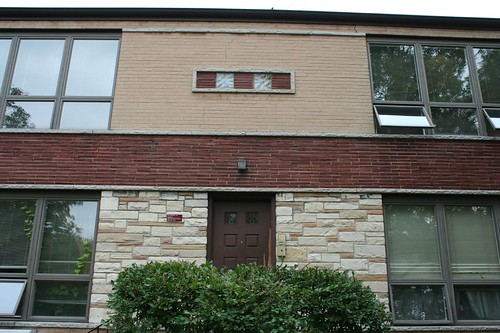
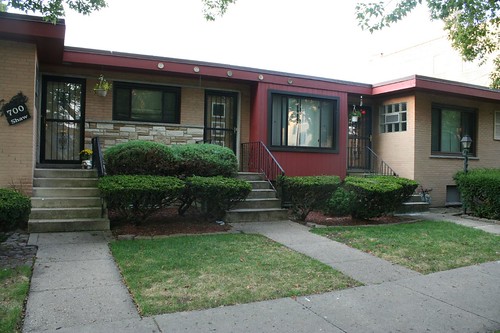
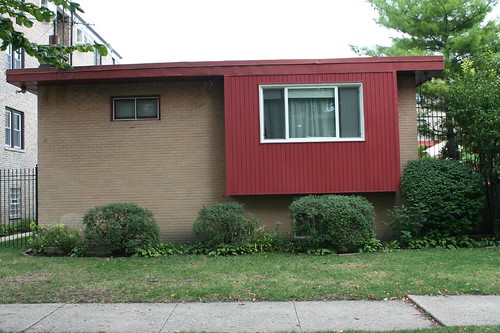
Hoffberg drew on a very distinct vocabulary of design ideas and facade materials: Flat roofs; picture windows set in square, boxed-out projecting bays or sloping walls, finished in wood siding and usually painted red or brown; rough-faced limestone banding at the windows; small patches of red Roman brick or flagstone; blonde brick.
IMG_7361

IMG_7338

IMG_7476a
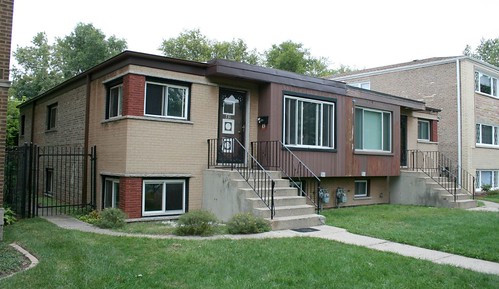
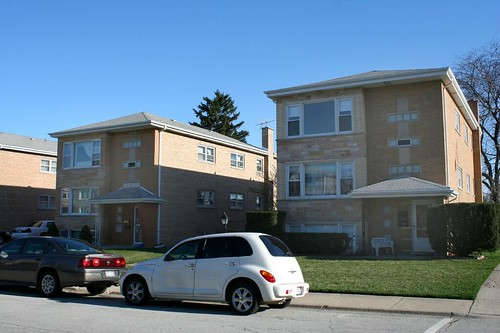
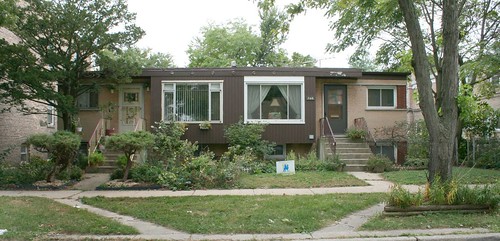
Hoffberg had a second design, seen above, that was useful for narrower or shallower sites, consisting of a simple twin or duplex design - two houses, 1 party wall. 729-31 Brummel Street, above, is a typical example. The building opened in 1956.

Here's a virtual duplicate at 738-40 Mulford Street:
IMG_7391a

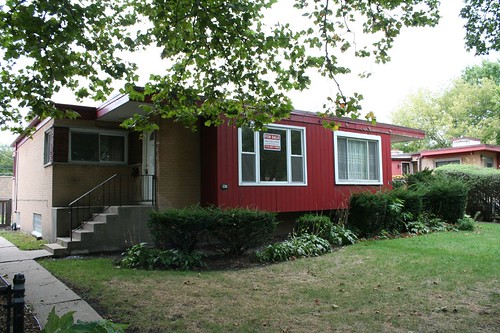
And another near-duplicate at 238-40 Custer, across the street from one of the courtyard townhouses. This one opened in September 1960, and was constructed by Elston Builders.
IMG_7387

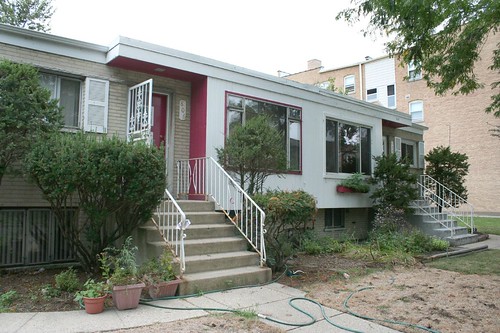
And here's the same idea again at 806-08 Mulford Street:
IMG_7410a


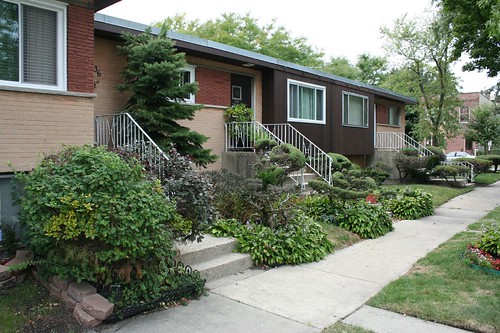
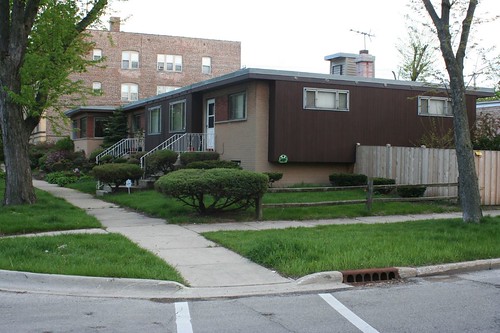
A third variation is a bit more free-form, with no courtyards.
IMG_1023

IMG_7402
244 Elmwood at Mulford Evanston - appears to have been standing by 1959; possibly by 1956.
IMG_7540
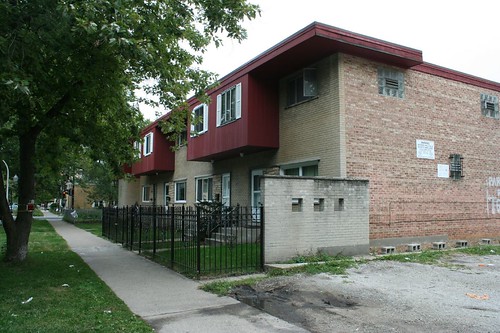
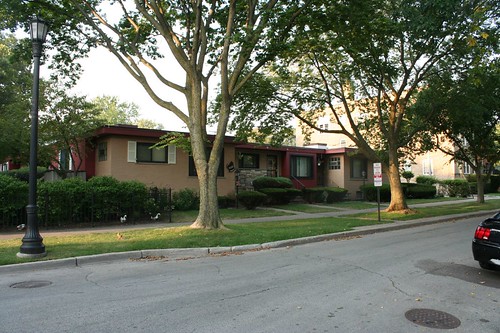
700-706 Shaw

Both of these occupy corner sites and are paired with a duplex building, apparently a response to a square site.
"Distinctive 5 room apartments with a distinctive address built for discrminating tastes" -- Tribune classifieds, 1955
Like most developers from the 1950s and 1960s, Alvin Hoffberg wasn't exactly a celebrity figure, so there's not a lot of info about him. Mr. Hoffberg shows up in 1947 as VP and general manager of Leonard W. Besinger & Associates, Inc., working on a group of homes in Park Ridge (bounded by Devon / Talcott / Cumberland / Glenlake / Vine), designed by architects Marin J. Green and William Kotek. Then came his run of indepdent buildings in the mid-1950s. And then, poof, nothing. Silence. Whatever became of Mr. Hoffberg, he didn't make any more headlines after the early 1960s.

There are some other buildings in the area that share similar materials, particularly that rough limestone trim and red Roman brick combo, and some indications that Hoffberg worked with a few other companies.
IMG_7502
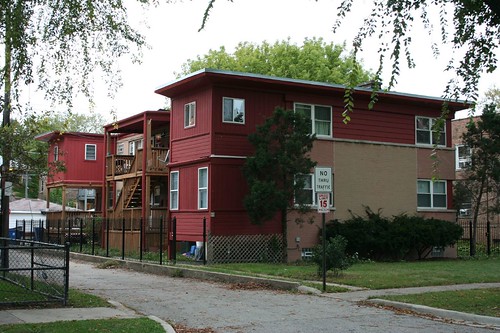
314-16 Callen, for example is a co-op apartment building that dates to 1954, was put up by the Town Development Co., and was advertised using his distinctive vocabulary.

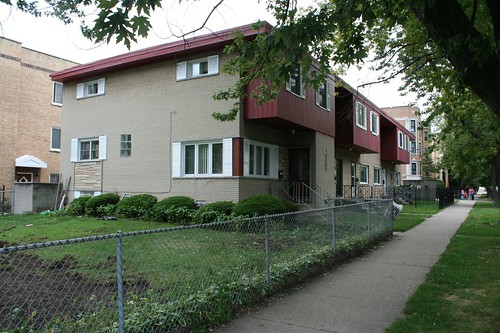
And 1601-09 W. Lunt, dating from 1964, is credited to Bannon-O'Donnel (realtors or builders, it's not clear), but has all the hallmarks of a Hoffberg design.
IMG_7317

IMG_7318

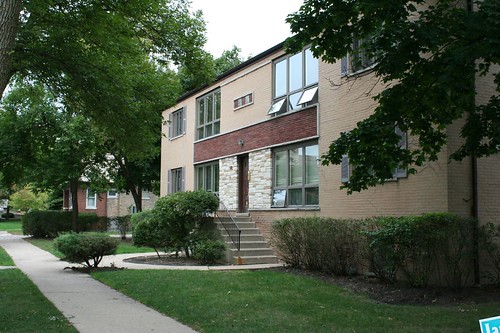
And these buildings are right across the street from the Elmwood/Mulford group, and use the exact same materials.
IMG_7404
301 Elmwood, Evanston

IMG_7412
300 Sherman, Evanston

IMG_7405
301 Elmwood detail...

IMG_7399
....and a detail from a known Hoffberg design across the street.

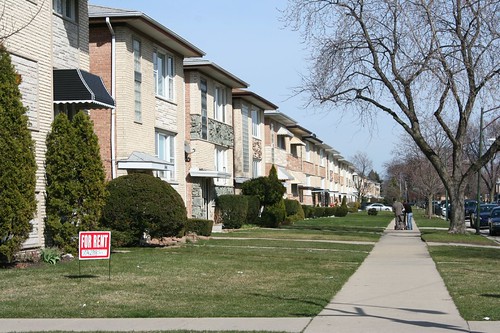
"Sensationally different - California one story - designed in the modern trend, for discrminating couples" - Chicago Tribune classified ad, 1955

Monday, April 5, 2010

No master plan, no guiding hand

After long study and research, I have reached a conclusion: there was no single guiding force that created the Chicago Midcentury style. It was simply an amazing confluence of factors.

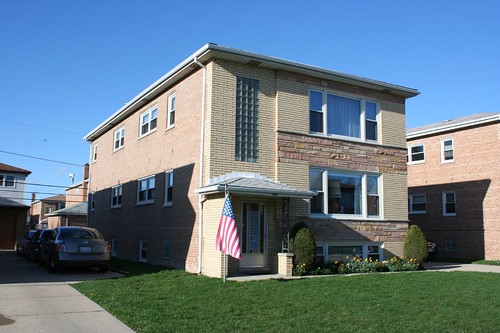
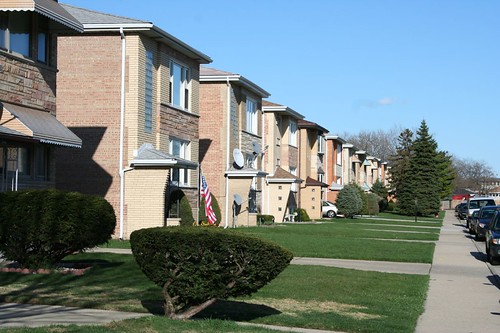
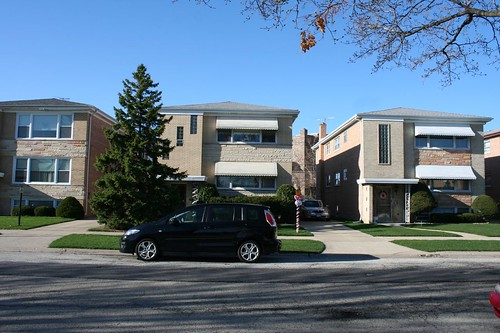
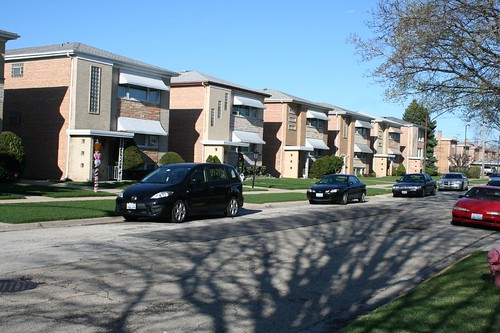
When I first noticed how prevalent this style was, the most obvious thought was that, perhaps, a single large builder developed huge swaths of Chicago. But I have encountered dozens or hundreds of builder names. The O'Hare neighborhood, which I marveled at recently, makes a great case study, containing many homogeneous blocks. Consider, for example, this three-block stretch of Berwyn, lined with nigh-identical 2-flats:

IMG_2906

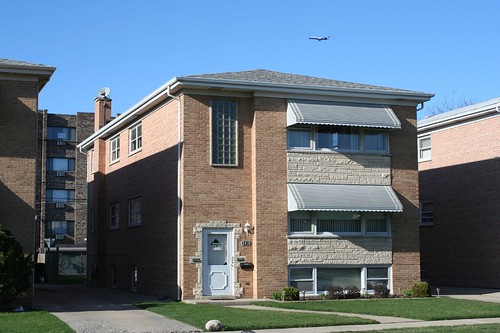
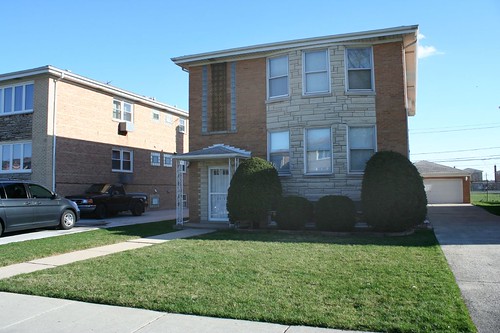
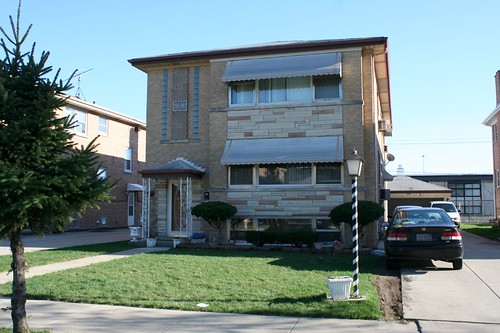
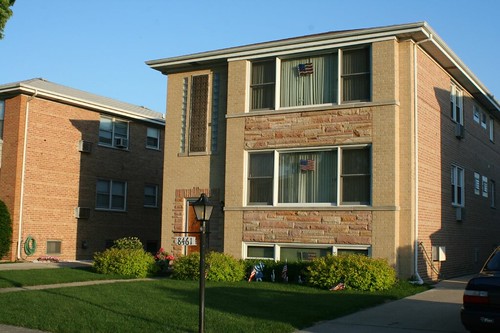
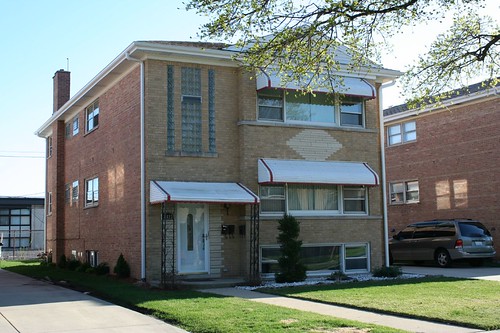
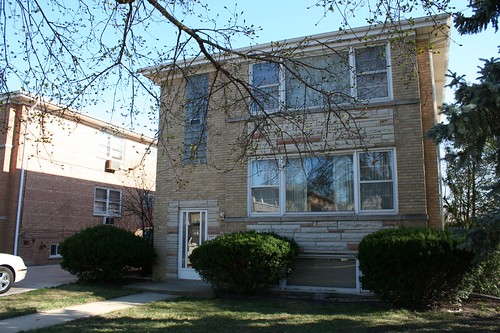
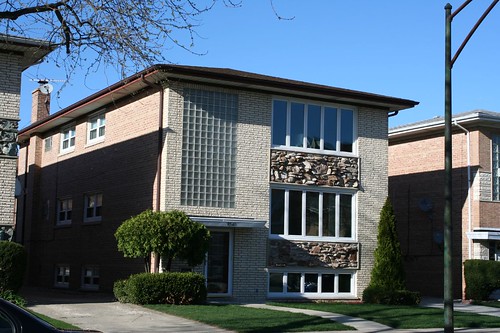
At a glance, these buildings are totally homegenous. They share identical massing, height, footprints, and unit layout (stairs on one side, two stacked units, giant picture windows.) Yet a careful look at their details shows that each builder did things a little bit differently, and had their own distinctive details that they used and re-used.

Take these buildings by the Relias Building Corporation, for example:
8359 and 8361 W. Berwyn Avenue
8359 and 8361 W. Berwyn Ave. The glass block design on the right is used on many Chicago MCM buildings.

8356 W. Berwyn Ave.
8356 W. Berwyn Ave

8300 block north, W. Berwyn Avenue
The 8300 block, north side. 8356 from the previous shot is at left. Notice the brick vestibule walls of each successive house - the first is the same as 8356, the next is a variation, and the next is a variation on the variation, and uses the same stairwell/glass block details as 8359 and 61 from the first shot. It's a good bet that Relias built this entire block.

But they sure didn't build the next two blocks!

8426 W. Berwyn Avenue
8426 W. Berwyn - Forest Lane Builders

8410 W. Berwyn
8410 W. Berwyn Avenue - Forest Lane Builders

8400 Block of W. Berwyn
And here's what stands between the two Forest Lane buildings. The repeating porch wall design makes it almost certain that the three center buildings, and the ones at the far right, were by a single builder. Could it also be Forest Lane? Sure. One of them even re-uses the glass block design from the first Forest Lane building. A look at an aerial view on Google Maps reveals that every building shares the exact same curved sidewalk design, too, meaning the whole north side of the block is probably Forest Lane. But that wall detail... didn't we just see that a moment ago, on a building by Relias? Did Forest Lane build on the Relias block, or did one company just swipe a detail from the other?

Across the street, another company was busy. Below are two buildings by Frank J. Munao, a wealthy builder who also happened to be into horse racing. He was so prominent, in fact, that some hoods attempted to extort money from him in the early 1950s by threatening his wife and children. They wound up going to jail instead, and Mr. Munao went on to grace Berwyn Avenue with these 2-flats:
8455 W. Berwyn Avenue

8435 W. Berwyn Avenue
8435 W. Berwyen Avenue

Given that distinctive concrete pattern block over the stairwell, it's a certainty that he also did these:
842? W. Berwyn Avenue
8423 W. Berwyn

8439 W. Berwyn
8439 W. Berwyn

8461 W. Berwyn
8461 W. Berwyn

And the same shape repeats here, minus the pattern block:
8427 W. Berwyn Avenue

So this whole side of the block is probably Frank J. Munao & Son, Inc.

One block west, and we're still in solid 2-flat territory, but with still more builders:

8555 W. Berwyn
8555 W. Berwyn - C.O.R. Construction Co.

8540 W. Berwyn Ave.
8540 W. Berwyn Avenue - Larry J. Pontarelli & Sons, Inc.

And so, in short, we've got three solid blocks of nothing but nigh-identical 3-flats.... by at least five different builders.

Further west on Berwyn, the 2-flats give way to 6-flats. Like the previous area, these buildings are rigorously aligned, and very similar in massing and style... but by a multitude of builders.

5222 N. Reserve Avenue
5222 N. Reserve Avenue - McNerney-Goslin, builder. They did a row of 5 or 6 buildings on this block.

5231 N. Reserve Avenue
5231 N. Reserve Avenue - David J. Cahill

5241 N. Potawatomie Avenue
5241 N. Potawatomie Avenue - Relias Building Corp.

8639 W. Berwyn Avenue
8639 W. Berwyn Avenue, SW corner of Berwyn and Potawatomie - aka 5240 N. Potawatomie. Ferlette Builders & Realty Co. Both this and the previous building (right across the street, and seeming to form a gateway with their prominent lamps) share New Formalist influences, but are by different builders. Clearly one of these buildings is reacting to the other.

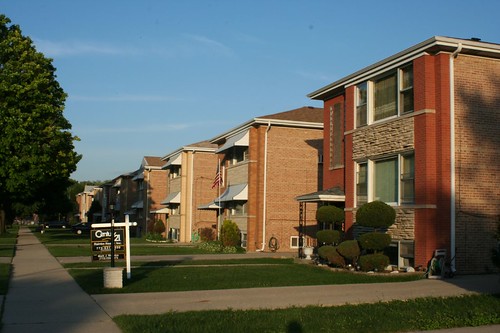
Most of these 6-flats, spanning three parallel streets, align so perfectly that you can look through the gaps between them and see through corresponding gaps in two more blocks of identical buildings. And every decorative trick on these buildings shows up on other buildings by other builders. These different builders were clearly borrowing from each other and trying to work together.

IMG_3016a

I have no solid explanation, though, for how this incredibly unified style came to be. As we've seen, a single builder was buying up a whole block, or large chunks of one, and stamping out the same designs. Zoning codes explain some of this homogeneity within neighborhoods, requiring similar dwelling unit types on blocks, setting setback limits and perhaps height restrictions as well. None of that, however, explains why a six-flat at 7600 N. Harlem Avenue (Parisi Brothers Construction Company) should look just like a 6-flat at 7724 W. Belmont Avenue (Nick S. Theodorau, architect) or one on 5200 N. Potawatomie.

The availability of affordable building materials is a likely factor - blonde brick, for example, was obviously cheap at the time. Brickmakers were experimenting with new cuts and colors at the time, as can be seen on many of these buildings. Many common components were catalog elements, such as the fancy doors and escutcheons and various kinds of glass block, and would have been readily available to any builder. Certain stone types that occur again and again were probably cheaply available as well, perhaps bought in bulk by local suppliers and sold to many contractors.

And then there was probably some good old fashioned peer pressure - all the cool kids are building modern-style apartments. Don'tcha wanna be cool? Builders are risk-adverse by nature; if they were building modern-clad buildings by the hundreds, it had to mean they were popular with the public. Certainly some of these elements were copped from famous designers of the day, and there was also a variety of cultural influences at work, too.

8700 Berwyn

Despite all the explanations, it's still a remarkable convergence. These factors, and perhaps others still unknown, combined to produce a distinctive Chicago style that appears all over the region, and to my knowledge, nowhere else.

(For the record, most of the builder and architect data comes from a series of real estate advertisements run throughout the 1960s by the Peoples Gas Light and Coke Company, touting the merits of gas heating and appliances. Names of architects appear far less frequently than names of builders, but there is still plenty of variety.)